Wine Sales Are Being Directed Toward Seagrass Restoration
Sea Change Wine is directing money from every sale to the Ocean Conservation Trust, supporting a 10-hectare seagrass restoration project in Falmouth Bay, Cornwall. The plan will use more than two million seeds and 21,000 nursery-grown seedlings.

A new conservation partnership links commercial activity in wine to the recovery of damaged marine habitat in Mallorca. Its wider significance will depend on transparent funding and measurable results.
What happened
A wine company has added marine habitat restoration to the conservation work funded through its sales. Sea Change Wine named SeaTrees as a new charity partner, with support directed toward the recovery of seagrass and macroalgae habitat around Mallorca in the Balearic Islands.
The underlying project is MedGardens, an initiative of the Cleanwave Foundation that has worked in Mallorca since 2020. Its model combines ecological restoration with research, marine debris removal, community participation, education and long term monitoring.
The announcement is modest in scale when set against global habitat loss. Its relevance lies elsewhere. It offers a visible example of how recurring commercial revenue from the wine sector can be connected to a defined environmental project rather than to a general sustainability claim.
What is being restored
Seagrasses are marine flowering plants that form meadows in shallow coastal water. These habitats provide nursery grounds for fish and invertebrates, filter pollutants and nutrients, retain sediment, reduce wave energy and store carbon in vegetation and the seabed.
The Mallorca programme is intended to restore underwater forests and seagrass meadows in shallow bays damaged by pressures that include marine debris and boat traffic. SeaTrees identifies one supported site at Formentor covering 53,820 square feet, approximately 5,000 square metres.
Restoration is not limited to planting. The programme includes removal of debris, scientific monitoring, community training, educational signage and work with authorities on more sustainable mooring practices. Cleanwave Foundation has set a broader ambition of contributing to the restoration of eight shallow bays in Mallorca by 2030.
What is confirmed
Sea Change states that a contribution from every bottle sold supports marine conservation and that more than €750,000 has been raised for charity partners since the brand launched in 2018. The company also reports lighter bottles, reduced packaging, plant based closures and label paper made partly from grape waste as elements of its environmental programme.
SeaTrees works with the Cleanwave Foundation on MedGardens in Mallorca. Public project information identifies Formentor as one of the initial locations and describes a combination of habitat reinforcement, research, volunteer participation, debris removal and ongoing care.
The ecological importance of seagrass extends beyond the project. The United Nations Environment Programme reports that seagrass covers only 0.1 per cent of the ocean floor while storing up to 18 per cent of oceanic carbon. It also provides nursery habitat connected to more than one fifth of the world's largest fisheries.
What remains unknown
The amount committed through the new partnership has not been publicly specified in the material reviewed. Nor is it clear whether funding is a fixed annual contribution, a defined amount per bottle, a share of revenue or a time limited commitment.
The share of the 53,820 square foot site attributable to this funding has not been disclosed. The published area describes the wider SeaTrees project and should not be presented as habitat restored solely by one company.
No new survival rate, biodiversity result or verified quantity of carbon stored has yet been attributed to the partnership. Restoration outcomes will require monitoring over time, and planted area alone cannot establish ecological recovery.
The company's cumulative charity total is broader than this initiative. It includes several organisations and projects and therefore cannot be assigned in full to seagrass restoration.
TCJ View
The useful question is not whether a wine label can carry an environmental message. It is whether commercial activity can create a reliable flow of money toward work that would otherwise remain underfunded.
Wine companies often describe sustainability through changes inside the bottle's immediate supply chain: lighter glass, reduced packaging, energy use, vineyard practices and transport. Those measures matter because they address the company's own footprint. Funding external restoration is different. It does not replace the obligation to reduce operational impact, but it can extend responsibility beyond the cellar and vineyard.
That distinction also creates an obligation to report clearly. A credible model should state how much money moves, where it goes, what period it covers and which ecological indicators will determine success. Without those elements, a restoration partnership risks being remembered more easily than the restoration itself.
The initiative is therefore best understood as a possible template, not a finished proof. A sector made up of thousands of producers, merchants, importers and retailers could direct even small recurring contributions toward local environmental work. The cumulative effect could become meaningful if the mechanism is transparent, independently managed and measured over time.
The important fact is not that one company has attached its name to seagrass. It is that wine revenue is being connected to the recovery of a specific habitat. The next test is whether the funding and the ecological outcome can be followed with equal clarity.
Sources
Sea Change Wine: conservation partners and cumulative fundraising
Sea Change Wine: impact statement and packaging claims
SeaTrees: Mallorca seagrass and macroalgae restoration project
Cleanwave Foundation: MedGardens programme and 2030 ambition
United Nations Environment Programme: seagrass ecosystems and global significance
Harpers Wine & Spirit: report on the new conservation partnership

WINE TASTING The Essential Guide
The Study Library · The Cellar Journal Wine tasting can look far more complicated than it really is. A professional puts their nose into a glass and starts talking about blackcurrants, violets, graphite, leather or wet stones, while someone listening may reasonably wonder whether all of those things are actually there,

ENGLISH WINE The Essential Guide
A complete introduction to English wine, connecting climate, geology, grapes, sparkling wine and modern history to explain how a marginal wine country became one of the world’s most dynamic cool-climate regions.
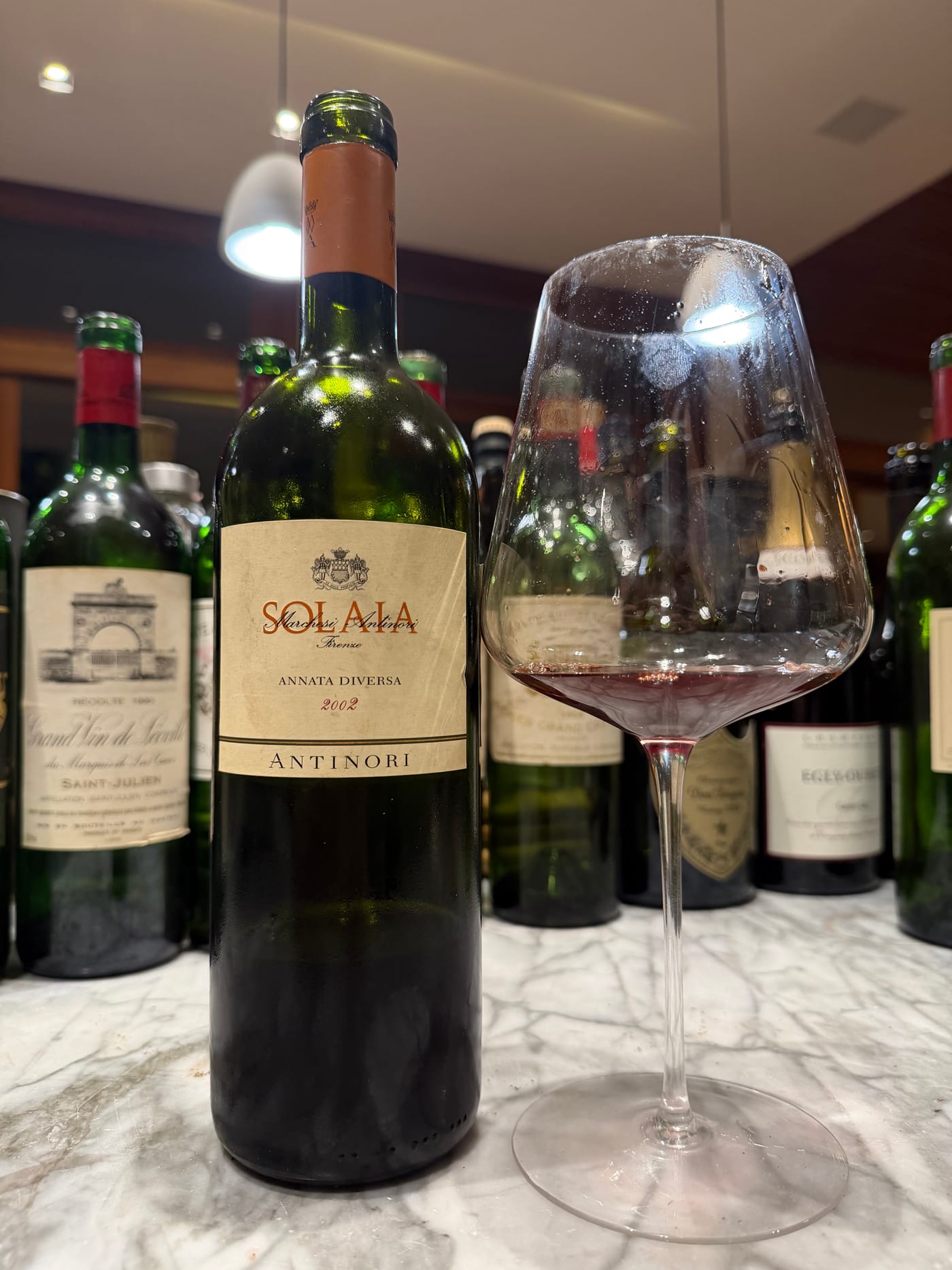
Solaia Annata Diversa 2002: A Different Vintage, a Singular Wine
Solaia 2002 is the only vintage to carry the words Annata Diversa, after a difficult Tuscan season removed Sangiovese from the blend. More than two decades later, the wine was alive, elegant and finely textured, with the composure of mature Bordeaux and an identity entirely its own.