Wine Moves from Boycott to a 50 Percent Tariff
A new 50 percent United States tariff brings Canadian wine directly into the trade dispute. TCJ separates the measures, market losses and unanswered questions.

The United States has imposed an additional 50 percent tariff on Canadian wine while provincial restrictions continue to obstruct American bottles in Canada. A retail retaliation has become a two-sided trade barrier.
What happened
On August 22, the United States began applying an additional 50 percent tariff to a range of Canadian imports that includes wine. The measure was announced by the White House on July 20 under Section 338 of the Tariff Act of 1930, a rarely used provision that permits a response to trade practices the United States considers discriminatory.
The wine measure is unusually broad. According to the White House, the additional duty applies to the covered Canadian goods even when they qualify under the United States-Mexico-Canada Agreement. Wine that had previously benefited from the regional trade framework therefore enters the United States with a new federal barrier that is separate from the political dispute over Canadian retail shelves.
Canada has announced retaliatory tariffs beginning September 8 after negotiations collapsed. Prime Minister Mark Carney said the response would match the new United States duties dollar for dollar. The initial sectors named by the Canadian government include steel, dairy, appliances, agricultural equipment, pulp and paper, and electronics. A complete product list had not been published when this Dispatch was filed.
What is confirmed
The conflict affecting wine did not begin with the new American tariff. In March 2025, provincial liquor authorities removed United States products from retail channels in response to earlier American trade measures. Ontario's LCBO stopped buying and selling American wine, beer, cider and spirits, and similar restrictions spread across much of Canada. Because provincial boards control important parts of alcohol distribution, the decision functioned as a market-access barrier even when a federal customs tariff was absent.
The commercial effect is measurable. Wine Institute reports that Canada was the largest destination for United States wine exports in 2024, representing 36 percent of global shipments and US$460 million in value. In 2025, exports to Canada fell 78 percent, reducing export value by US$357 million. Canada's share of United States wine exports fell from 36 percent to 12 percent in one year.
Those figures come from the principal advocacy organisation for California wine and should be read as an industry presentation of trade data. They nevertheless establish the scale of the disrupted market. The dispute has not merely changed political language. It has removed a major destination from the operating assumptions of American producers, importers and distributors.
From provincial shelves to federal tariffs
The new element is the direction of the pressure. Until now, wine was most visible as a Canadian instrument against American exporters. Provincial boards could remove products quickly and with national commercial consequences, even though the decisions were formally provincial. The United States has now answered with a border measure that directly affects Canadian wine entering its market.
That change matters because tariffs and retail exclusions operate differently. A tariff raises the cost of entry but may leave a route to market. A purchasing ban or delisting can close the principal route altogether. The two measures are now layered across the same trading relationship, reducing predictability on both sides of the border.
The sequence also exposes a structural characteristic of the Canadian market. Wine policy is divided among federal trade authority and provincial distribution systems. Ottawa can negotiate, but it cannot treat every provincial purchasing decision as if it were a single federal tariff. Washington, meanwhile, has chosen a national import duty to answer restrictions that were implemented through provincial monopolies. The result is a dispute in which the institutions do not align neatly, but producers absorb the consequences immediately.
What remains unknown
Canada has not yet published the complete schedule for its September 8 retaliation. It is therefore not confirmed that American wine will receive a new Canadian tariff in addition to the provincial restrictions already in place. Reporting that wine is definitely part of the next Canadian package would go beyond the available facts.
It is also unclear whether Ontario, Quebec and other provinces will restore American products as part of a future agreement. Some provincial leaders had discussed reopening their systems during negotiations, but no uniform and durable reversal has been established. Consumer behaviour may also remain altered even if official barriers are removed.
The duration of the American measure is another open question. The White House did not provide an automatic expiry date, and the use of Section 338 may face legal scrutiny. No source can yet establish how much Canadian wine volume will be redirected, which producers will withdraw from the market or whether negotiations will resume before the Canadian countermeasures take effect.
TCJ View
The political statements are the least useful part of this story. Each government describes the other as the cause of the dispute. For wine, the relevant fact is simpler: a market that once appeared protected by a continental trade agreement has become vulnerable to both administrative delisting and exceptional tariffs.
Wine is often treated as a secondary casualty of larger disputes. Here it is closer to the centre. Canada was the largest foreign market for United States wine, provincial liquor boards possess unusual purchasing power, and the American proclamation explicitly identifies alcohol policy as grounds for retaliation. Wine is not decorative evidence of a trade war. It is one of the mechanisms through which the conflict is being conducted.
For TCJ, the deeper issue is not which government wins the argument. It is how quickly political action can erase the predictability on which agricultural regions depend. Vines cannot be moved when a market closes, and export relationships built over decades are not restored by removing a tariff line. The most important number may not be 50 percent. It may be the 78 percent collapse that occurred before the new duty existed, because it shows that market access can disappear long before a formal trade agreement is rewritten.
Sources
Wine Spectator: Canada and America Officials Trade Blame in Latest Tariff Battle
https://www.winespectator.com/articles/canada-and-america-officials-trade-blame-in-latest-tariff-battle
The White House: fact sheet on additional tariffs imposed on Canadian imports under Section 338
https://www.whitehouse.gov/fact-sheets/2026/07/fact-sheet-president-donald-j-trump-imposes-additional-tariffs-on-canada/
Liquor Control Board of Ontario: response to United States tariffs and removal of American products
https://www.lcbo.com/content/lcbo/en/corporate-pages/lcbo-response-to-u-s--tariffs--q-a.html
Wine Institute: full-year 2025 data on the decline in United States wine exports to Canada
https://wineinstitute.org/press-releases/one-year-later/
Reuters: Canada announces retaliatory tariffs beginning September 8 after trade negotiations collapse
https://www.reuters.com/business/carney-says-new-canadian-tariffs-us-goods-will-come-into-effect-september-8-2026-08-22/
WINE TASTING The Essential Guide
The Study Library · The Cellar Journal Wine tasting can look far more complicated than it really is. A professional puts their nose into a glass and starts talking about blackcurrants, violets, graphite, leather or wet stones, while someone listening may reasonably wonder whether all of those things are actually there,

ENGLISH WINE The Essential Guide
A complete introduction to English wine, connecting climate, geology, grapes, sparkling wine and modern history to explain how a marginal wine country became one of the world’s most dynamic cool-climate regions.
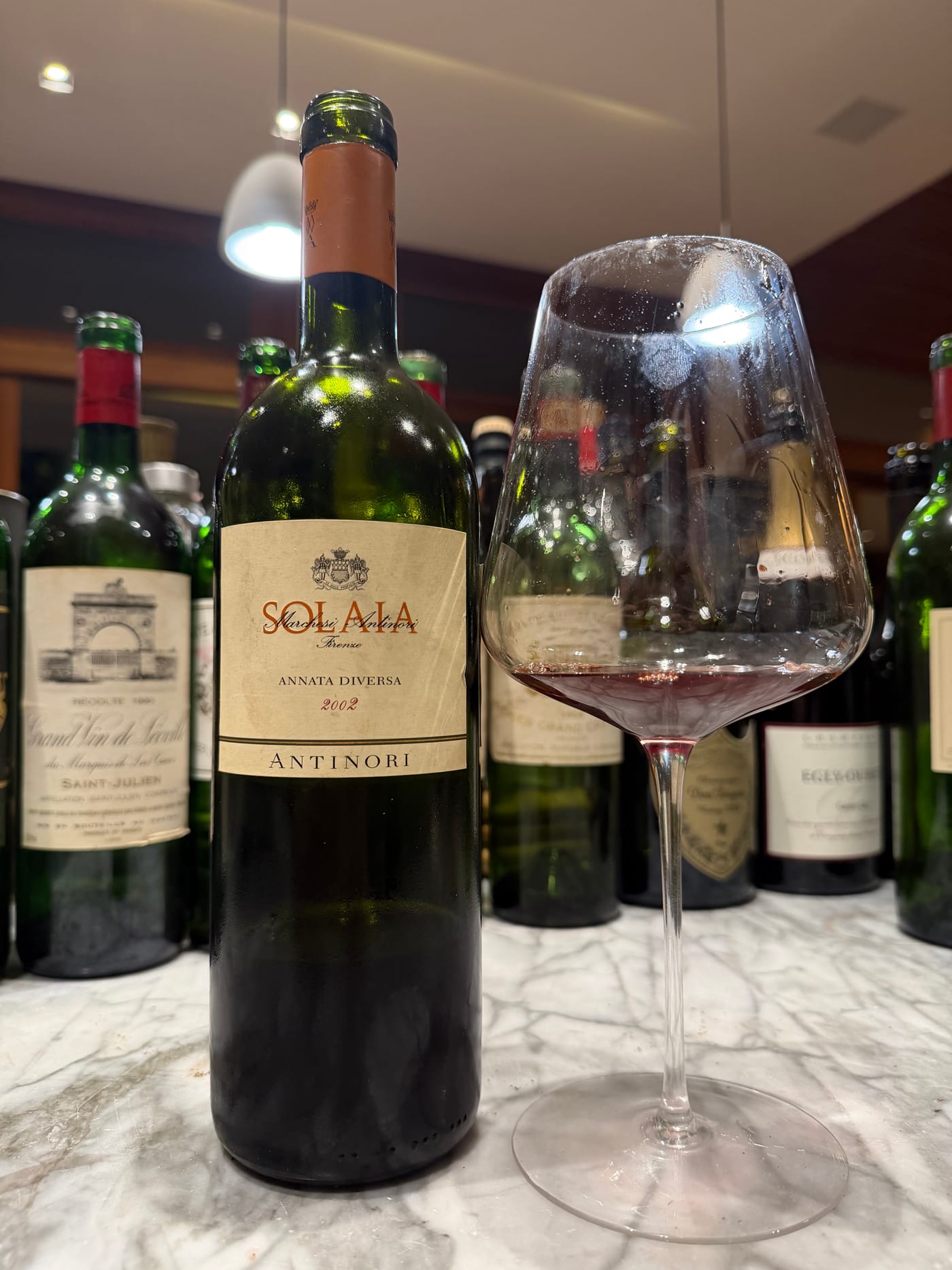
Solaia Annata Diversa 2002: A Different Vintage, a Singular Wine
Solaia 2002 is the only vintage to carry the words Annata Diversa, after a difficult Tuscan season removed Sangiovese from the blend. More than two decades later, the wine was alive, elegant and finely textured, with the composure of mature Bordeaux and an identity entirely its own.