When Grape Marc Becomes Transport Fuel

French wine distilleries already recover ethanol from hundreds of thousands of tonnes of grape marc. A new national climate strategy gives that system greater relevance, but volume, vehicle compatibility and verified life-cycle emissions still define its limits.
What happened
France is giving biofuels a larger place in its transport strategy, and the wine sector is presenting grape marc as one of the residual feedstocks already available. The third National Low-Carbon Strategy, known as SNBC-3, targets complete decarbonisation of domestic transport by 2050 and a 14.5 percent reduction in the carbon intensity of transport energy by 2030, using electrification together with higher incorporation of sustainable fuels.
Against that policy background, Raisinor director Jerome Budua told Le Figaro that French distilleries collect between 800,000 and one million tonnes of grape marc each year. The material consists principally of skins, seeds and other solid residues left after pressing or fermentation. Distilleries wash and process it to recover residual alcohol, then direct the remaining fractions toward several other uses.
Raisinor says it is also working on fuel pathways in which renewable components would replace more of the fossil share in products such as E85, and on solutions approaching E100. No industrial capacity, investment figure, certification, launch date or production target was disclosed. This is therefore a development programme, not an announced commercial deployment.
What is already operating
The conversion of wine residues into transport fuel is not new. Raisinor states that its network brings together almost all French wine distilleries and supplies advanced bioethanol made from non-food vinous residues. That ethanol is already incorporated into E5, E10 and E85 petrol blends and is also used to produce ED95.
ED95 contains up to 95 percent ethanol, with the balance consisting of additives that enable ignition and lubrication. France authorised it in 2016 for specially adapted compression-ignition engines, principally in captive heavy-vehicle fleets such as buses and coaches. The technical rules were amended again in April 2026. ED95 is therefore a regulated fuel with real applications, but it is not compatible with the general diesel fleet.
Regional transport trials demonstrate that the route has moved beyond the laboratory. Buses powered by grape-marc ED95 have operated in Nouvelle-Aquitaine and Occitanie since 2018 and 2019. These deployments prove technical use. They do not establish national market scale.
The scale behind the headline
The annual quantity of marc is substantial within the wine economy. Independent sector reporting commonly places French collection near 850,000 tonnes, broadly consistent with the range cited by Raisinor. A 2020 industry estimate calculated that distilling 100,000 tonnes of marc could recover about 40,000 hectolitres of pure alcohol. Applied mechanically to 850,000 tonnes, that ratio would imply roughly 340,000 hectolitres, or 34 million litres, before formulation into finished fuels.
That calculation is an order-of-magnitude illustration, not a current production figure. Alcohol yield changes with the condition of the marc, the vinification method, the vintage and the efficiency of each distillery. Not every litre is necessarily directed to transport. Sector reporting has placed vinous-residue ethanol at about 3 percent of total French bioethanol production, which shows both its industrial reality and its limited national weight.
Marc also supports a cascade of other products. Distillation and further processing can recover grape-seed oil, tartaric compounds, polyphenols, anthocyanins, animal-feed ingredients, compost and energy. Sending more material toward fuel creates allocation choices within a system that already has several markets. The relevant question is not whether the residue can be used, but which use creates the strongest environmental and economic value.
What the emissions claims mean
Raisinor says its process can recycle or recover 99.9 percent of the collected material. That figure describes material valorisation as presented by the company. It is not a 99.9 percent reduction in carbon emissions, and Le Figaro does not provide an independent audit or a boundary definition for the claim.
On its corporate sustainability page, Raisinor reports that a life-cycle assessment found ED95 produced through its system could reduce greenhouse-gas emissions by 74 percent compared with diesel and reduce fossil-energy use by 70 percent compared with gas. The company also describes an environmental-impact reduction of more than 80 percent under selected indicators. These figures come from an assessment published by the producer and should not be treated as a universal result for every distillery or transport application.
French policy requires biofuels to demonstrate life-cycle greenhouse-gas savings, generally at least 50 percent relative to the fossil equivalent and 60 percent for newer installations. That method includes production and processing rather than looking only at the exhaust pipe. Combusting ethanol still releases carbon dioxide. Its climate case depends on the carbon being biogenic, the feedstock being a genuine residue, and the collection, distillation and distribution chain remaining efficient.
What remains unknown
The new E85 and E100 work lacks the information required for an independent assessment. There is no confirmed output, cost per litre, energy balance, engine pathway, source of the renewable replacement component or certified life-cycle result. It is also unclear whether the initiative would expand existing distilleries, create regional units or rely on centralised processing.
Supply is not fixed. Marc volume follows the grape harvest, while climate pressure, lower yields, vineyard removal and changing wine production can reduce the feedstock available in a given year. Collection also carries distance and moisture penalties because marc is bulky, wet and seasonal. A circular fuel can lose part of its advantage if it is transported too far or dried with carbon-intensive energy.
The national contribution is therefore not established by the tonnage alone. France needs several transport pathways, and the SNBC-3 places electrification at the centre of the transition. Residue-based fuels may be most useful where direct electrification is difficult, or where a local feedstock and captive fleet can be connected without building a long supply chain.
TCJ View
The interesting story is not that wine waste can suddenly power vehicles. France has been doing that for years. The shift is that an infrastructure created to manage vinification residues is being reconsidered as part of national energy policy. A distillery is no longer only an environmental service to wineries. It can also become a regional biorefinery.
For wine regions, the strongest model may be local rather than national. Marc collected after harvest can be processed near the vineyards and used in buses, coaches or freight fleets that operate on predictable routes. Such a loop does not replace electrification or transform the French fuel market. It can reduce fossil dependence inside the territory that produced the residue.
TCJ sees a necessary distinction between circularity and scale. Recovering value from an unavoidable byproduct is credible. Presenting that byproduct as a major answer to transport emissions requires evidence that has not yet been published. The next meaningful announcement will not be another estimate of how many tonnes of marc exist. It will be a verified project showing how much fuel is produced, what it displaces, what the full cycle emits and whether the economics survive beyond a pilot fleet.
Sources
Le Figaro Vin: Entre 800 000 et 1 million de tonnes par an, comment le marc de raisin pourrait participer a la decarbonation des transports, published August 26, 2026
https://avis-vin.lefigaro.fr/economie-du-vin/entre-800-000-et-1-million-de-tonnes-par-an-comment-le-marc-de-raisin-des-viticulteurs-pourrait-participer-a-la-decarbonation-des-transports-20260826
French Ministry for Ecological Transition: SNBC-3 objectives for the transport sector
https://www.ecologie.gouv.fr/strategie-nationale-bas-carbone/transports
French Ministry for Ecological Transition: biofuels, feedstocks and life-cycle sustainability criteria
https://www.ecologie.gouv.fr/politiques-publiques/biocarburants
French Ministry for Ecological Transition: fuels authorised in France and ED95 use conditions
https://www.ecologie.gouv.fr/politiques-publiques/carburants-combustibles-autorises-france
Legifrance: April 21, 2026 order amending the technical rules for ED95
https://www.legifrance.gouv.fr/jorf/id/JORFTEXT000054067934
Raisinor Bioethanol: company description, markets and published life-cycle claims
https://www.raisinor-bioethanolavance.com/notre-entreprise/
https://www.raisinor-bioethanolavance.com/demarche-rse/
Reussir Vigne: sector data on grape-marc ethanol yield, co-products and share of French bioethanol production
https://www.reussir.fr/vigne/un-biocarburant-95-issu-du-marc-de-raisin

WINE TASTING The Essential Guide
The Study Library · The Cellar Journal Wine tasting can look far more complicated than it really is. A professional puts their nose into a glass and starts talking about blackcurrants, violets, graphite, leather or wet stones, while someone listening may reasonably wonder whether all of those things are actually there,

ENGLISH WINE The Essential Guide
A complete introduction to English wine, connecting climate, geology, grapes, sparkling wine and modern history to explain how a marginal wine country became one of the world’s most dynamic cool-climate regions.
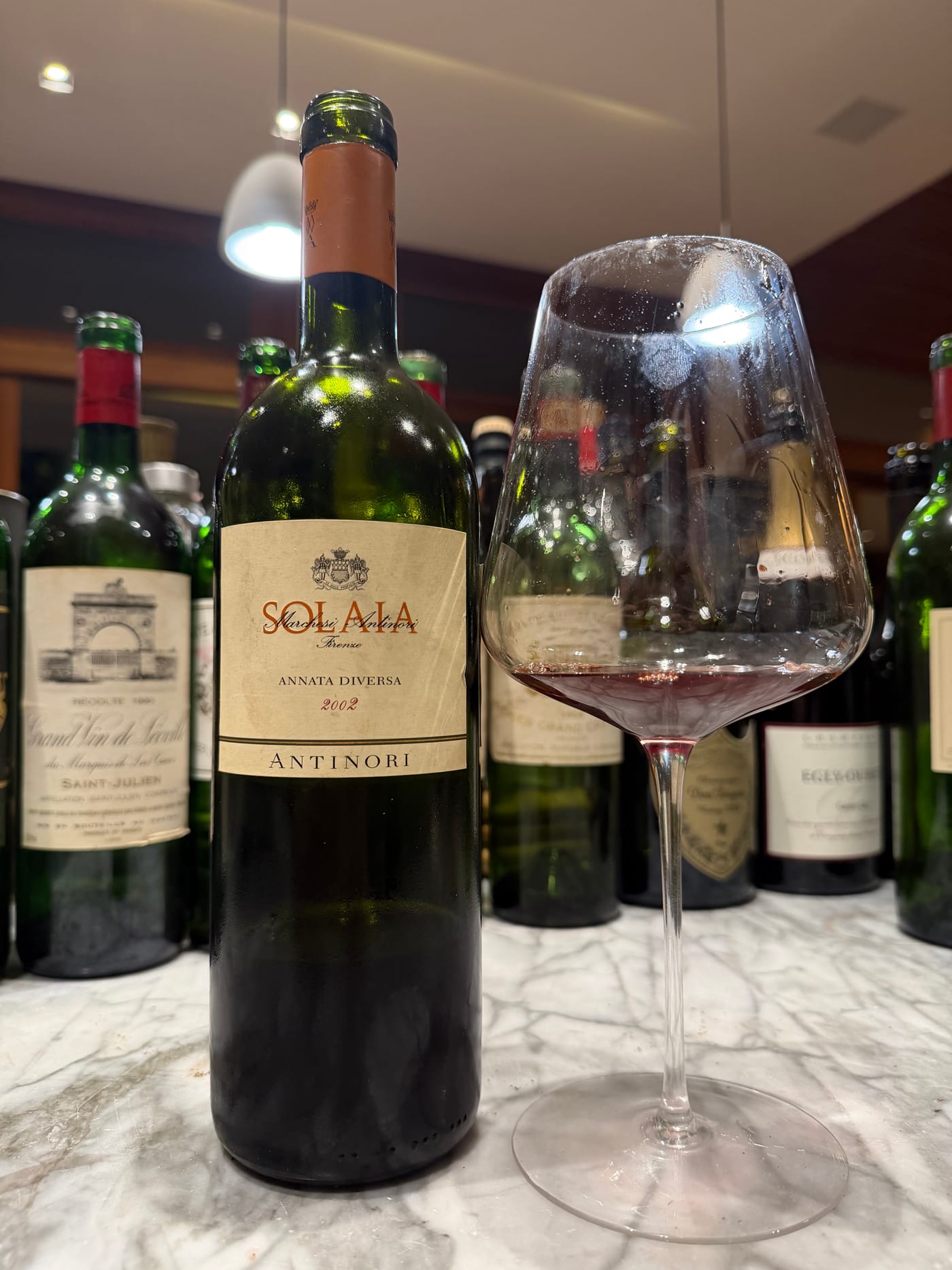
Solaia Annata Diversa 2002: A Different Vintage, a Singular Wine
Solaia 2002 is the only vintage to carry the words Annata Diversa, after a difficult Tuscan season removed Sangiovese from the blend. More than two decades later, the wine was alive, elegant and finely textured, with the composure of mature Bordeaux and an identity entirely its own.