What the Wine and Intelligence Study Actually Found

An online study found that cognitive-test scores were associated with performance on a wine-theory quiz. The result is real within the sample, but it does not show that wine makes people smarter, that wine preference signals intelligence or that factual recall defines expertise.
What happened
A brief report published in Intelligence & Cognitive Abilities has examined whether general cognitive ability is associated with knowledge in a voluntary specialist field. Researchers Maximilian Krolo of Saarland University and Timothy C. Bates of the University of Edinburgh selected wine because its classifications, regions and production methods form a structured body of information that most people are neither required nor paid to learn.
The paper is titled Bright People Know More About Wine. That wording is likely to travel farther than the method. The study did not compare the intelligence of people who choose wine with those who choose other drinks, and it did not test whether wine changes cognition. It compared scores from a short cognitive assessment with scores from a wine-knowledge questionnaire in the same group of participants.
What the researchers measured
The sample consisted of 525 adults recruited through the online research platform Prolific. Their average age was 43.15. The group included 257 women and 268 men, and 457 participants were identified as White. Most, 458, reported no professional experience in wine. The paper does not present this as a population-representative sample.
Cognitive ability was measured with 36 items from the International Cognitive Ability Resource. The selected tasks covered letter and number sequences, matrix reasoning, and verbal reasoning. The researchers combined the three results and standardised the composite score within their own sample to a mean of 100 and a standard deviation of 15. This was a brief research measure, not an individual clinical or educational assessment.
Wine knowledge was measured through 68 multiple-choice questions adapted from public materials associated with the WSET Level 2 syllabus. The questions covered vineyard influences, winemaking, grape varieties, regions, sparkling and fortified wine, storage, service and pairing. It was not the official WSET examination, it was completed online without proctoring, and it contained no tasting component. The mean score was 24.49 out of 68.
Professional exposure was reduced to four self-reported categories, from none to certified retail experience. Personal exposure was represented by one broad preference question that placed respondents into teetotal, beer-preferring or wine-preferring groups. Frequency, years of study, qualifications, reading, travel, purchasing, household background and access to wine education were not measured in detail.
What the study found
Higher composite cognitive scores were associated with higher wine-quiz scores. The standardised relationship was beta 0.31, with a 95 percent confidence interval from 0.22 to 0.39 and p below .001. In the simplest model, cognitive ability accounted statistically for 9.4 percent of the variation in wine-knowledge scores.
Adding occupational exposure improved the model. Professional wine experience was independently associated with knowledge, and the relationship between cognitive score and quiz performance was stronger among participants with greater occupational exposure. Adding drinking preference also improved prediction, but preference did not strengthen the relationship between cognitive score and knowledge. In the full model, cognitive ability, occupational exposure and beverage preference together accounted for 17.8 percent of the variation in quiz scores.
The clearest practical finding is therefore not that choosing wine denotes intelligence. It is that structured professional exposure was associated with more knowledge and appeared to amplify the relationship between cognitive ability and performance. A stated preference for wine was associated with a higher score, but it did not produce the same interaction.
What the headline does not prove
The design was cross-sectional. Every variable was measured over two short online sessions, so the study observed relationships at one point in time. It did not follow people while they learned, randomly assign education or establish which factor caused another. The authors acknowledge that longitudinal research would be required for stronger causal inference.
The study was motivated partly by a desire to examine knowledge outside school, work and socioeconomic incentives. Yet it did not directly control for educational attainment, income or socioeconomic status. That matters because wine knowledge can involve course fees, books, travel, professional networks, time and cultural familiarity. The paper itself acknowledges wine as a socially valued and sometimes status-signalling field. Calling it incentive-neutral is therefore an interpretation, not a measured condition.
There is also overlap between what was used to predict and what was predicted. The verbal component of the cognitive measure includes vocabulary and general knowledge, while the wine test is itself a test of learned verbal and factual knowledge. Verbal reasoning had the strongest correlation with the wine score at .37; matrix reasoning had a weaker correlation of .14. This does not erase the association, but it narrows what can be concluded about intelligence as a single, general cause.
Most of the variation remained outside the models. An IQ-only model left 90.6 percent of the observed variation in wine scores unaccounted for, and the full model left 82.2 percent. Those percentages do not identify the missing causes. They simply prevent the measured association from becoming a complete explanation of wine knowledge.
Knowledge is not the whole of expertise
The research measured declarative knowledge: the ability to select correct answers about grapes, geography and production. That is a legitimate part of wine education, and WSET officially describes Level 2 as a beginner to intermediate qualification covering important varieties, regions and styles. But declarative knowledge is not identical to sensory discrimination, memory, judgment, communication or the capacity to understand a producer and place in context.
The distinction matters to the wine world. A person can learn classifications efficiently and still have limited practical experience. Another can develop precise sensory attention or deep local knowledge without performing equally well on a broad international quiz. The study did not rank these forms of expertise because it did not measure them.
Its more useful educational implication is narrower. Repetition, classification and feedback appear important. The association with occupational exposure suggests that a structured environment may turn contact into retained knowledge more effectively than unorganised exposure. That is relevant to schools, producers, restaurants and publications that want to teach, but it is not evidence for making wine culture more exclusive.
TCJ View
Wine has spent centuries borrowing the language of hierarchy. Regions are ranked, vineyards are classified, critics assign numbers and collectors convert scarcity into status. A headline linking wine knowledge with intelligence enters that culture carrying more symbolic weight than a beta coefficient. It can be used to flatter insiders and discourage newcomers even when the underlying study supports neither reaction.
TCJ sees a valid result and an overextended story. The valid result is that performance on one cognitive measure was associated with performance on one theoretical wine test in an online sample, and that structured professional exposure mattered. The overextended story begins when this becomes a claim about the intelligence of wine drinkers, the value of drinking or the superiority of people who know more labels and classifications.
The most constructive reading is not that wine belongs to brighter people. It is that wine knowledge is learnable, structured and incomplete. Cognitive ability may influence how quickly some people organise information, but access, teaching, practice, curiosity, language and lived experience still shape what knowledge becomes. A serious wine culture should use research to improve how it teaches, not to decide who deserves to enter.
Sources
Krolo, Maximilian, and Timothy C. Bates: Bright People Know More About Wine, Intelligence & Cognitive Abilities, accepted July 24, 2026
https://doi.org/10.65550/001c.165719
Saarland University: Bright people know more about wine: How higher intelligence is reflected in deep domain knowledge, published August 26, 2026
https://www.uni-saarland.de/en/news/kluge-menschen-wissen-mehr-ueber-wein-hoehere-intelligenz-fachwissen-50176.html
Phys.org: Bright people know more about wine: How higher intelligence is reflected in deep domain knowledge, published August 25, 2026
https://phys.org/news/2026-08-bright-people-wine-higher-intelligence.html
Wine & Spirit Education Trust: WSET Level 2 Award in Wines, qualification scope and assessment
https://www.wsetglobal.com/qualifications/wset-level-2-award-in-wines
WINE TASTING The Essential Guide
The Study Library · The Cellar Journal Wine tasting can look far more complicated than it really is. A professional puts their nose into a glass and starts talking about blackcurrants, violets, graphite, leather or wet stones, while someone listening may reasonably wonder whether all of those things are actually there,

ENGLISH WINE The Essential Guide
A complete introduction to English wine, connecting climate, geology, grapes, sparkling wine and modern history to explain how a marginal wine country became one of the world’s most dynamic cool-climate regions.
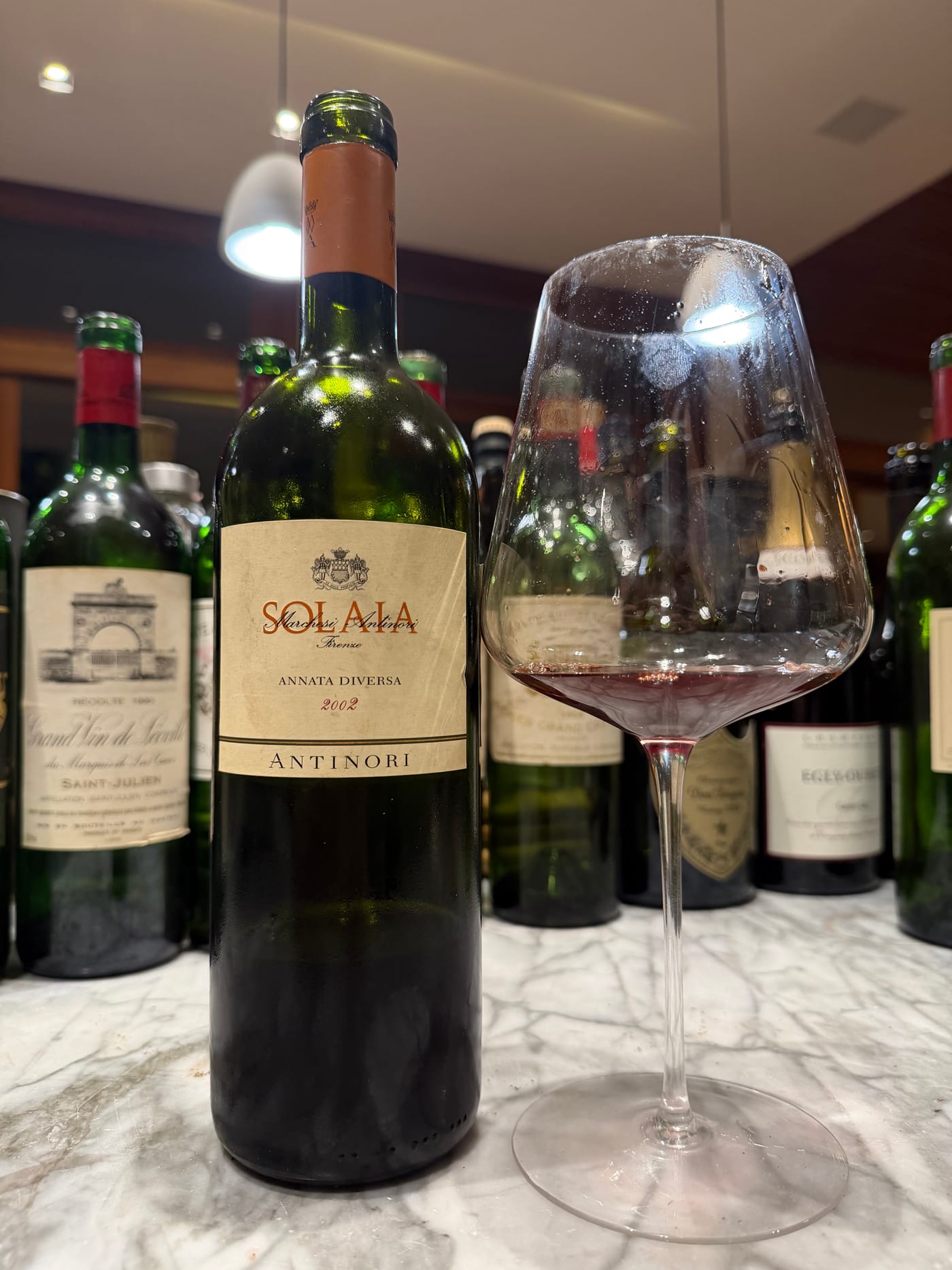
Solaia Annata Diversa 2002: A Different Vintage, a Singular Wine
Solaia 2002 is the only vintage to carry the words Annata Diversa, after a difficult Tuscan season removed Sangiovese from the blend. More than two decades later, the wine was alive, elegant and finely textured, with the composure of mature Bordeaux and an identity entirely its own.