What the Marathon du Médoc Generates Beyond 42 Kilometres
The Marathon du Médoc brings 8,500 runners and 3,000 volunteers into Pauillac. TCJ examines how one race converts an appellation into tourism, media and civic infrastructure.

The 40th edition will bring 8,500 runners and around 3,000 volunteers to Pauillac. Its importance lies in how one race turns a wine appellation into a public stage for tourism, media and collective identity.
What happened
The Marathon des Châteaux du Médoc will hold its 40th edition on September 5, 2026. The 42.195 kilometre course begins and ends in Pauillac, crossing a landscape of vineyards and estates that has made the race recognisable far beyond conventional running circles. The theme for the anniversary edition is the 1980s.
A report published by Courrier International, based on a Wall Street Journal article, has renewed attention on the event's most photogenic contradiction: a full marathon combined with about 20 wine tasting stations and regional food. That is an effective international headline, but it explains only part of what the event has become.
The marathon now functions across an entire weekend. Its official programme begins in Pauillac on Friday with the race village and organised gatherings, continues through Saturday's race and public programme, and ends on Sunday with a recovery walk in Saint Julien Beychevelle limited to 3,000 people. The race is the centre, but the economic and cultural footprint extends well beyond the start and finish lines.
What is confirmed
The organising association deliberately caps the field at 8,500 runners, and registration for 2026 is closed. The association says the cap protects the event's ability to receive participants properly. Demand has exceeded capacity for years, although a recent independently verified breakdown of applicants by country is not public.
The operating scale is substantial. The official volunteer page calls for a team of 3,000 people, while the core association is built around 90 volunteer marathon runners. The organiser also lists a medical operation of 300 people, ten care stations along the route and five specialised tents at the finish. This is not an improvised celebration attached to a road race. It is temporary regional infrastructure.
The Saturday programme specifies 22 refreshment points, about 20 moderated wine tastings and 55 entertainment or food locations. The organisers also state that participation in the tastings is optional and describe the servings as limited. That distinction matters because alcohol and endurance exercise are physiologically in tension, a risk also emphasised by the sports nutrition specialist quoted by the Wall Street Journal.
What the race generates
The first effect is movement. Thousands of runners, companions, volunteers, media workers and suppliers converge on a small wine town at the end of the summer season. The official programme creates demand for accommodation, transport, restaurants and temporary event services over several days rather than during a single morning.
There is at least one current indicator of that pressure. Airbnb reported that searches for accommodation in Pauillac around the 2025 race dates were 34 percent higher than for the 2024 edition. This is company data about searches, not confirmed bookings or total visitor spending, but it supports the conclusion that the marathon changes short term demand for beds in the town.
The second effect is organisational. Three thousand volunteers represent more than one person for every three runners. Estates, municipalities, medical teams, transport providers, food suppliers and residents become part of the same temporary system. The event therefore produces social capacity as well as visitor traffic. It asks the region to coordinate itself and to receive outsiders collectively.
The third effect is media value. An American newspaper can present the event as a cultural curiosity, while a French publication can republish that outside gaze. Each cycle returns Pauillac and the Médoc to an international audience that may know the appellation through labels but has never imagined it as an inhabited landscape. The Institut Paris Region cites the marathon as a successful example of sport used to promote a territory beyond a strictly sporting public.
What remains unknown
No recent audited study establishes the marathon's total economic impact. Public sources do not provide a verified count of spectators, hotel nights, restaurant revenue, estate visits, local tax receipts or the share of visitors who extend their stay. They also do not separate spending that remains in the Médoc from spending captured in Bordeaux or by national and international operators.
An academic study of the race estimated direct economic effects at 7.12 million French francs, but its fieldwork belongs to the event's early history and cannot be treated as a current valuation. The Airbnb search figure is more recent, yet it measures interest on one platform rather than the regional economy.
The environmental balance is similarly incomplete. The organiser reports local sourcing, public transport measures, waste sorting and rapid course cleaning. Those actions are relevant, but no current public assessment accounts for visitor travel, temporary installations, water use and the full volume of waste generated across the weekend.
TCJ View
Wine regions often try to create relevance by adding visitor centres, restaurants or increasingly polished tasting programmes. The Marathon du Médoc works differently. It temporarily makes the appellation itself the venue. Roads, vineyards, estates, residents and local food become parts of one public narrative.
Its strongest asset is not the novelty of serving wine during a marathon. That image attracts coverage, but it can also flatten the event into a joke and obscure legitimate health questions. The more consequential achievement is the network required to host 8,500 runners with 3,000 volunteers and to keep people in the territory for three days.
For TCJ, this is what the race generates that matters most: a form of regional visibility that cannot be purchased through advertising alone. The Médoc is shown not only as a source of famous bottles, but as a place capable of coordinating hospitality, sport and public life. The next step should be measurement. After 40 editions, the event's cultural power is evident. Its economic, social and environmental effects deserve the same clarity.
Sources
Courrier International: French summary of the Wall Street Journal report on the 2026 racehttps://www.courrierinternational.com/article/vu-des-etats-unis-au-marathon-du-medoc-du-vin-du-fromage-et-42-kilometres-cherchez-l-intrus_262837
The Wall Street Journal: original report on the Marathon du Médoc and its health contradictionhttps://www.wsj.com/lifestyle/wine-cheese-and-26-2-miles-what-could-go-wrong-86ec588d
Marathon des Châteaux du Médoc: official programme, history, participant cap, medical resources and volunteer scalehttps://www.marathondumedoc.com/programme/ | https://www.marathondumedoc.com/lesprit-du-medoc/ | https://www.marathondumedoc.com/benevoles/
Airbnb Newsroom: accommodation search interest around French running events, including Pauillachttps://news.airbnb.com/fr/quand-lengouement-pour-les-courses-a-pied-dope-le-tourisme-en-france/
Institut Paris Region: sport, territorial marketing and the Marathon du Médoc as a regional promotion modelhttps://www.institutparisregion.fr/amenagement-et-territoires/amenagement/sport-et-marketing-territorial-association-vertueuse/
Maison des Sciences de l'Homme d'Aquitaine: Olivier Bessy's historical economic study of the racehttps://books.openedition.org/msha/16613
WINE TASTING The Essential Guide
The Study Library · The Cellar Journal Wine tasting can look far more complicated than it really is. A professional puts their nose into a glass and starts talking about blackcurrants, violets, graphite, leather or wet stones, while someone listening may reasonably wonder whether all of those things are actually there,
ENGLISH WINE The Essential Guide
A complete introduction to English wine, connecting climate, geology, grapes, sparkling wine and modern history to explain how a marginal wine country became one of the world’s most dynamic cool-climate regions.
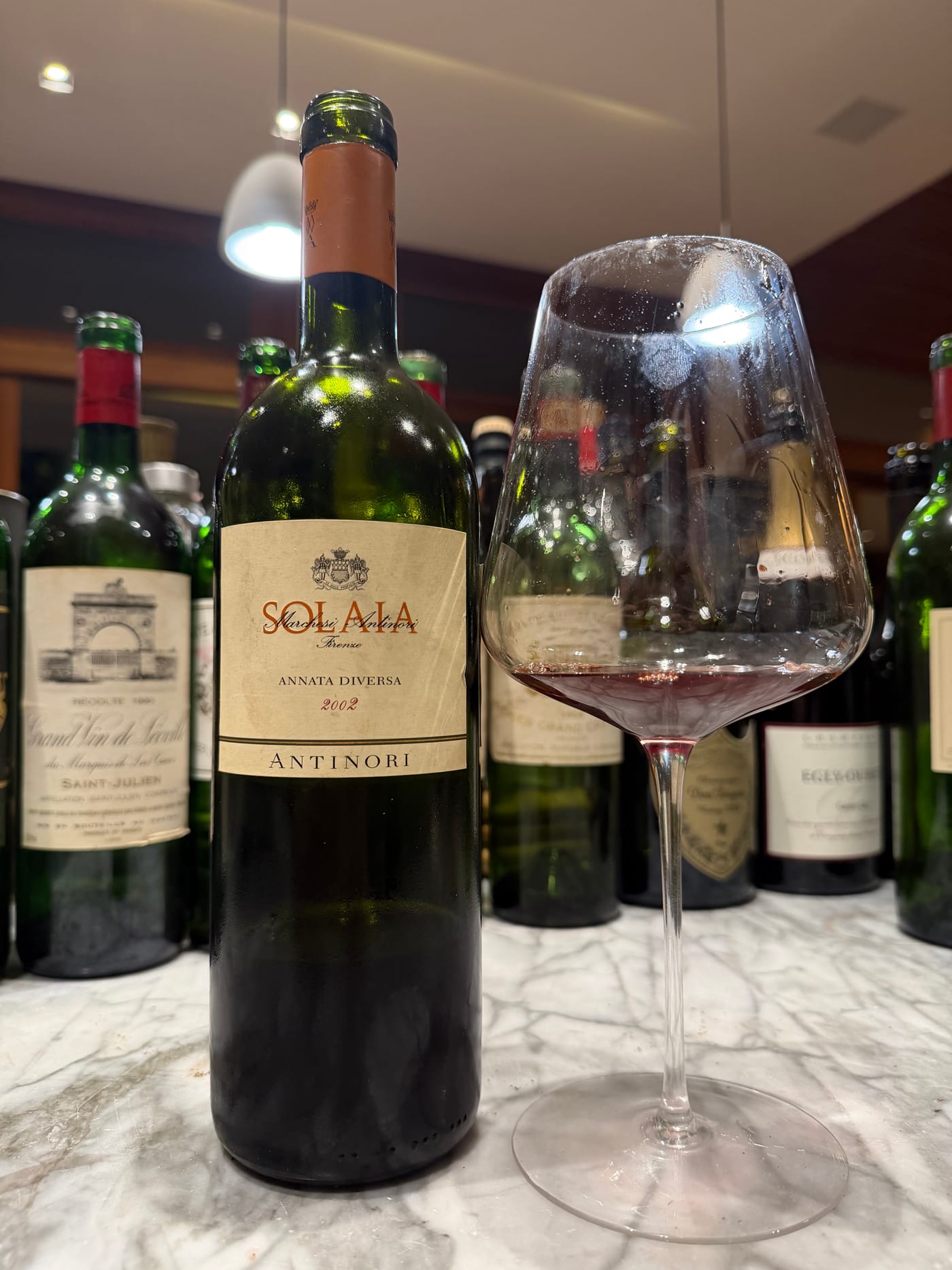
Solaia Annata Diversa 2002: A Different Vintage, a Singular Wine
Solaia 2002 is the only vintage to carry the words Annata Diversa, after a difficult Tuscan season removed Sangiovese from the blend. More than two decades later, the wine was alive, elegant and finely textured, with the composure of mature Bordeaux and an identity entirely its own.