The €5 Million Antinori Theft Was Not a Random Wine Crime
Thirty thousand bottles worth €5 million were stolen from an Antinori warehouse in Tuscany. The operation reveals a growing vulnerability in fine wine: authentic bottles can retain their labels while losing the provenance that supports their value.

Thirty thousand bottles disappeared from a warehouse in Tuscany in a carefully organised operation. The scale of the Antinori theft reveals how valuable wine has become, and how vulnerable it can be once it enters the global distribution chain.
What happened
Around 30,000 bottles of Marchesi Antinori wine, valued at approximately €5 million, were stolen from the company’s warehouse in Cortona, Tuscany, during the weekend of October 3 and 4.
According to Antinori, surveillance footage shows seven masked people entering the facility, disabling the alarm system and loading the wine onto two trucks. The bottles had already been prepared for export, allowing the group to remove an unusually large volume in a relatively short period of time.
The theft was discovered on Monday morning, when employees returned to the warehouse. Italian police are investigating, but no arrests or recoveries had been announced when this Dispatch was published.
Among the wines taken were Tignanello, Guado al Tasso and between 8,000 and 10,000 bottles of Solaia, one of the most internationally recognised wines produced in Italy. Italian reports indicate that the stolen bottles were from the 2023 vintage. The total value has been estimated at €5 million, equivalent to approximately US$5.8 million.
This was not a thief leaving a restaurant cellar with a few famous bottles concealed in a bag. It required vehicles, time, knowledge of the warehouse and the ability to identify stock that could command considerable value outside its official route to market.
The wine was stolen by the truckload.
What is confirmed
Marchesi Antinori has produced wine since 1385 and remains controlled by the Antinori family. Today, its wines are distributed in approximately 170 countries, making the group one of the most visible names in Italian fine wine.
The selection of bottles matters. Tignanello, first produced in the 1970s, helped alter the course of modern Tuscan wine by moving beyond the conventions that then governed Chianti Classico. Solaia subsequently became one of Italy’s most sought-after collectible labels, while Guado al Tasso established Antinori’s presence in Bolgheri.
These are not obscure wines that require a specialist to explain their importance. They have established names, international demand and active secondary markets. That makes them desirable targets, but it also makes 30,000 bottles difficult to hide.
Renzo Cotarella, chief executive of Marchesi Antinori, said the planning and execution suggested a highly organised group. The company has alerted customers and distributors around the world, asking them to be cautious about bottles offered through unusual channels or at implausibly attractive prices.
That warning is more than an attempt to recover inventory. It is an effort to protect provenance.
Once stolen wine re-enters the market, the distinction between an authentic bottle and a legitimate bottle becomes essential. The liquid, glass and label may all be genuine, but the chain of ownership has been broken. A buyer can acquire the real wine and still be purchasing stolen property.
For merchants, restaurants and collectors, provenance is therefore not limited to protection against counterfeiting. It also requires confidence that the bottle moved legally from producer to distributor, retailer and final owner.
A pattern beyond Antinori
The size of the Antinori theft makes it exceptional, but it is not an isolated event.
In July, thieves took around 3,000 carefully selected bottles from a Banfi storage facility. In September, approximately 3,000 bottles of Barolo were stolen from Conterno Fantino in Piedmont, where the perpetrators reportedly used a forklift and remained inside the warehouse for several hours.
Earlier wine crimes usually attracted attention because of the rarity of individual bottles. Restaurant cellars and private collections offered compact targets in which a small number of wines could represent hundreds of thousands of euros. The recent Italian cases follow a different model. They target producers and warehouses, prioritising scale, recognisable labels and stock already organised for distribution.
This changes the nature of the risk. A rare bottle can disappear into a private collection. Ten thousand bottles of the same Solaia vintage require storage, transport and multiple routes back into commerce. Moving that quantity without attracting attention will demand a network, not merely a buyer.
It also means that the legitimate trade becomes part of the investigation. Importers, auction houses, retailers, restaurants and collectors are the places where suspicious offers may eventually become visible. A sudden supply of current-release wines, especially at prices meaningfully below the market, is much harder to explain than a single mature bottle appearing at auction.
Why wine has become an attractive target
Fine wine combines several qualities that appeal to organised theft. It is valuable, portable, internationally traded and difficult for most consumers to trace beyond the label. Unlike jewellery or art, bottles can be divided into small lots and sold gradually through different markets.
The growth of global demand has also given certain names an immediate monetary identity. A case of Solaia or Tignanello requires no explanation in London, New York, Hong Kong or São Paulo. The brand recognition that helps a producer sell internationally can also make its stock more attractive to criminals.
At the same time, wine warehouses were designed primarily around temperature, logistics and efficient movement. The Antinori theft shows why security and traceability must now carry similar weight. Once valuable bottles are packed together and prepared for export, they become concentrated assets with a clear route out of the building.
Digital inventory systems, lot identification and bottle-level authentication can make stolen wines harder to circulate, but only if information moves quickly across the trade. Serialised bottles are of limited value if merchants and buyers do not know which numbers have been compromised.
The industry’s defence therefore depends on cooperation as much as technology. Producers must be able to identify affected lots. Distributors and retailers need to question unexpected supply. Collectors must understand that a low price from an unknown seller is not merely a commercial opportunity.
What remains unknown
Investigators have not said whether the group had inside information, whether the two trucks have been identified or where the stolen wine may have been taken after leaving Cortona.
It is also unclear how precisely the bottles can be traced. Current vintages may carry production and packaging codes, but Antinori has not publicly released a detailed list of affected lots or individual bottle identifiers. Without that information, buyers can recognise suspicious circumstances more easily than they can verify a specific bottle.
The possibility that the same group was involved in the Banfi or Conterno Fantino thefts has been raised by Cotarella, but remains a hypothesis. Similar methods and knowledgeable selection suggest a pattern; they do not yet establish a single criminal organisation.
What is already clear is that the wines cannot be sold at this scale through normal channels without leaving traces. The task is to recognise those traces before the bottles become dispersed across countries, cellars and restaurant lists.
TCJ View
The Antinori theft is significant not because famous wine makes an entertaining crime story, but because it exposes a weakness in the fine-wine economy.
The market devotes enormous attention to authenticity, storage and condition. Legal provenance often receives less scrutiny, particularly when a bottle itself appears entirely genuine. This case shows that the question should not only be whether the wine is real, but also how it reached the seller.
Thirty thousand authentic bottles can become problematic inventory overnight. Their labels remain intact. Their commercial history does not.
For producers, the episode should force a reassessment of warehouse security and bottle-level tracking. For the trade, it reinforces the responsibility to examine unusually priced or unexpectedly available stock. For collectors, it offers a simple reminder: provenance is not paperwork added to a bottle after the transaction. It is part of the value of the wine itself.
The thieves knew what to take. The next test is whether the wine world is sufficiently connected to prevent them from selling it.
Selected Sources
- Reuters, “Tuscan winemaker Antinori sees red after $6 million theft”
https://www.reuters.com/world/tuscan-winemaker-antinori-sees-red-after-6-million-theft-2026-10-09/ - Financial Times, “Famous Italian winery loses 30,000 bottles worth €5mn in heist”
https://www.ft.com/content/1b614d60-a5d3-4b9f-b3e8-63f51bdfd599 - Corriere della Sera, “Alla Marchesi Antinori il più grande furto di vino”
https://www.corriere.it/cook/vini/26_ottobre_09/marchesi-antinori-furto-vino-5-milioni-1112dac6-6b72-4cb0-ae49-3315f73abxlk.shtml - Rai News, “Maxi furto di vini pregiati da 5 milioni nell’azienda Marchesi Antinori”
https://www.rainews.it/articoli/2026/10/maxi-furto-alla-cantina-antinori-di-cortona-rubate-30mila-bottiglie-per-5-milioni-di-euro-970134ab-e6c2-4c1c-94b5-7f686c22dd54.html
WINE TASTING The Essential Guide
The Study Library · The Cellar Journal Wine tasting can look far more complicated than it really is. A professional puts their nose into a glass and starts talking about blackcurrants, violets, graphite, leather or wet stones, while someone listening may reasonably wonder whether all of those things are actually there,

ENGLISH WINE The Essential Guide
A complete introduction to English wine, connecting climate, geology, grapes, sparkling wine and modern history to explain how a marginal wine country became one of the world’s most dynamic cool-climate regions.
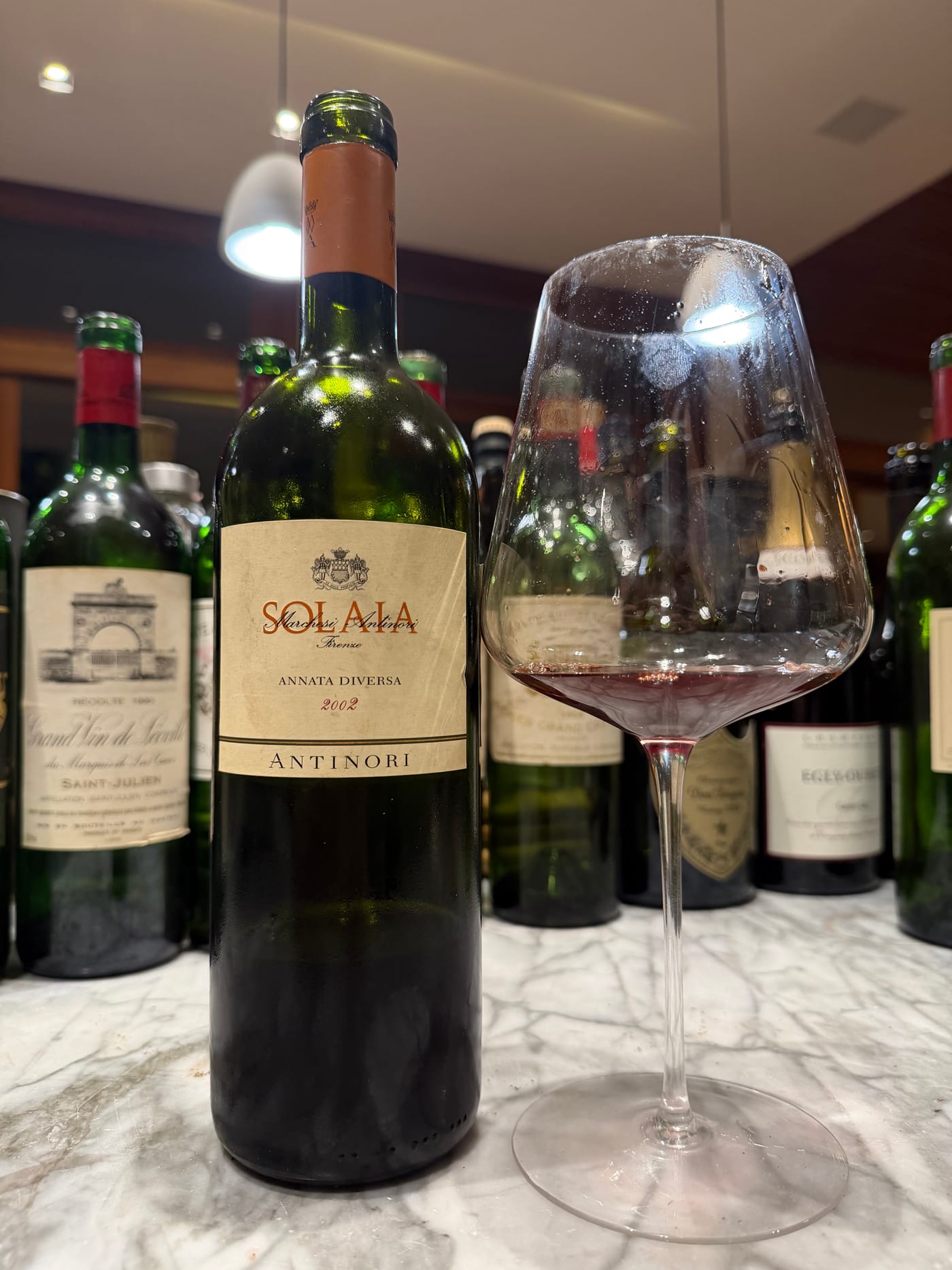
Solaia Annata Diversa 2002: A Different Vintage, a Singular Wine
Solaia 2002 is the only vintage to carry the words Annata Diversa, after a difficult Tuscan season removed Sangiovese from the blend. More than two decades later, the wine was alive, elegant and finely textured, with the composure of mature Bordeaux and an identity entirely its own.