Montalcino Is Harvesting Earlier and Planning Five Years Ahead

The 2026 Sangiovese harvest is beginning at least a week earlier than last year. The more consequential decision came before picking: Montalcino reduced the volume that can be declared as Brunello while citing inventories, value and the cost of holding wine for a distant market.
What happened
The main phase of the 2026 Brunello di Montalcino harvest is expected to begin on September 7, although some estates have already started picking their first Sangiovese parcels. That is at least one week earlier than in 2025 and several weeks earlier than in cooler vintages.
The Consorzio del Vino Brunello di Montalcino says the harvest should extend for approximately three weeks because conditions and ripening dates vary across the denomination. Its pre-harvest assessment describes the vineyards as healthy and expected production as similar to, or slightly below, 2025.
The growing season was marked by high temperatures, but the vines had access to water during important stages of development. Veraison was already observed in mid-July, and the advance continued through ripening. These observations come from vineyard sampling conducted through Brunello Forma, the consortium project that has monitored the relationship between grape variety, climate and wine since 2024.
An early harvest is not yet a quality verdict
The consortium expects high quality, but that statement needs to be read for what it is: a pre-harvest assessment based on vine health, sampling and the condition of the grapes. Fermentation, extraction, ageing and selection have not happened. The 2026 wines cannot yet be evaluated.
An earlier date is also not automatically evidence of a weaker or stronger vintage. It describes the speed of the growing cycle. The final balance will depend on whether sugars, acidity, tannins and aromatic development reached suitable maturity together, and on how individual sites responded to heat and rainfall.
The September 7 start is significant, but it has not been presented as a historical record. Montalcino has experienced other advanced seasons, while the 2024 harvest began in October after a much slower cycle. The contrast shows how widely the calendar can move from one vintage to another.
The decision that came before the harvest
In May, the consortium approved a lower ceiling for the amount of grapes that can be claimed as Brunello in 2026. The first hectare registered by each producer retains the regulatory maximum of 80 quintals per hectare. From the second hectare onward, the maximum claimable volume falls to 70 quintals per hectare.
The measure does not necessarily require the remaining grapes to be discarded. Up to 10 quintals per hectare affected by the reduction may instead be allocated to Rosso di Montalcino or Sant'Antimo. The maximum yield for Rosso di Montalcino remains 90 quintals per hectare.
The distinction matters. A reduction in the volume declared as Brunello is not the same as an equivalent reduction in the agricultural crop. It changes how part of that crop can enter the market, under which denomination and on what timetable.
The 2026 crop is a decision about 2031
Brunello from the 2026 harvest cannot be released before January 1, 2031. The production rules require at least two years in oak and at least four months in bottle within a release schedule that keeps the wine off the market for nearly five years. A Riserva reaches the market one year later.
Rosso di Montalcino operates on a different clock. It may be released from September 1 of the year following harvest. Directing part of the crop from Brunello to Rosso or Sant'Antimo therefore changes more than the name on the label. It changes how long a producer must finance, store and wait for that wine.
This is why the consortium's explanation is more revealing than the harvest date alone. It says yield restraint has historically protected quality positioning, but that the 2026 decision also responds to market conditions. Excess availability, it said, can create pressure through inventories, storage requirements and the financial commitments made by producers.
Strong demand and inventory caution can exist together
The decision should not be simplified into evidence that Brunello demand has collapsed. Consortium data for the United States, its largest export market, showed Brunello volumes sold through distributors rising 7.7% in 2025 while the wider market fell 8.8%. Value increased by 2%. The United States absorbs more than 30% of Brunello exports.
Those figures cover one market and one stage of distribution. They do not describe every producer, export destination or vintage held in cellar. A denomination can outperform the wider category and still face uneven inventories, higher financing costs or slower movement in other channels.
The consortium represents 219 members and 98.2% of Brunello production. More than 2,000 hectares are registered for Brunello, and approximately 10 million bottles are marketed in an average year. At that scale, controlling claimable yield becomes a collective instrument for managing future supply, not simply a vineyard technique.
What is confirmed
The main harvest is expected to start on September 7 and continue for about three weeks. Veraison arrived early, vineyards sampled through Brunello Forma were in positive sanitary condition, and production is expected to be in line with or slightly below 2025.
For 2026, the first hectare remains eligible for up to 80 quintals per hectare as Brunello. From the second hectare onward, the limit is 70. The difference may be assigned to Rosso di Montalcino or Sant'Antimo under the applicable rules.
What remains unknown
No complete harvest volume is available because picking has only begun. The final quantity declared as Brunello, Rosso di Montalcino and Sant'Antimo will depend on actual yields and decisions made by individual estates.
The consortium has not published a current numerical inventory figure, a target reduction in future bottle supply or a producer-level analysis of financing and storage pressure. Nor can the eventual quality or style of the 2026 Brunello be determined before vinification and ageing.
TCJ View
The early harvest is the visible event. The more important story is that Montalcino is managing two clocks at once.
The first is biological. Heat advanced veraison and brought the Sangiovese closer to harvest sooner. The second is economic. A grape declared as Brunello in 2026 will not reach the market until 2031, while the same territory can place Rosso di Montalcino into commerce much earlier.
That distance makes every yield decision an estimate of a market that does not yet exist. Producers are not only selecting grapes for quality. Collectively, they are deciding how much Brunello the world may receive five years from now, while working with today's inventories, costs and demand.
The policy also raises a useful question. When a denomination reduces claimable yield to protect value, where does quality control end and supply management begin? In Montalcino, there may be no clean separation. The long ageing period that defines Brunello's identity also makes volume a financial commitment.
Climate is accelerating the vineyard, but the denomination cannot accelerate time in the same way. The 2026 harvest shows the resulting tension clearly: grapes are arriving earlier, while the market for their most important name remains five years away.
Sources
Consorzio del Vino Brunello di Montalcino: 2024 harvest begins in October, published October 3, 2024
WINE TASTING The Essential Guide
The Study Library · The Cellar Journal Wine tasting can look far more complicated than it really is. A professional puts their nose into a glass and starts talking about blackcurrants, violets, graphite, leather or wet stones, while someone listening may reasonably wonder whether all of those things are actually there,
ENGLISH WINE The Essential Guide
A complete introduction to English wine, connecting climate, geology, grapes, sparkling wine and modern history to explain how a marginal wine country became one of the world’s most dynamic cool-climate regions.
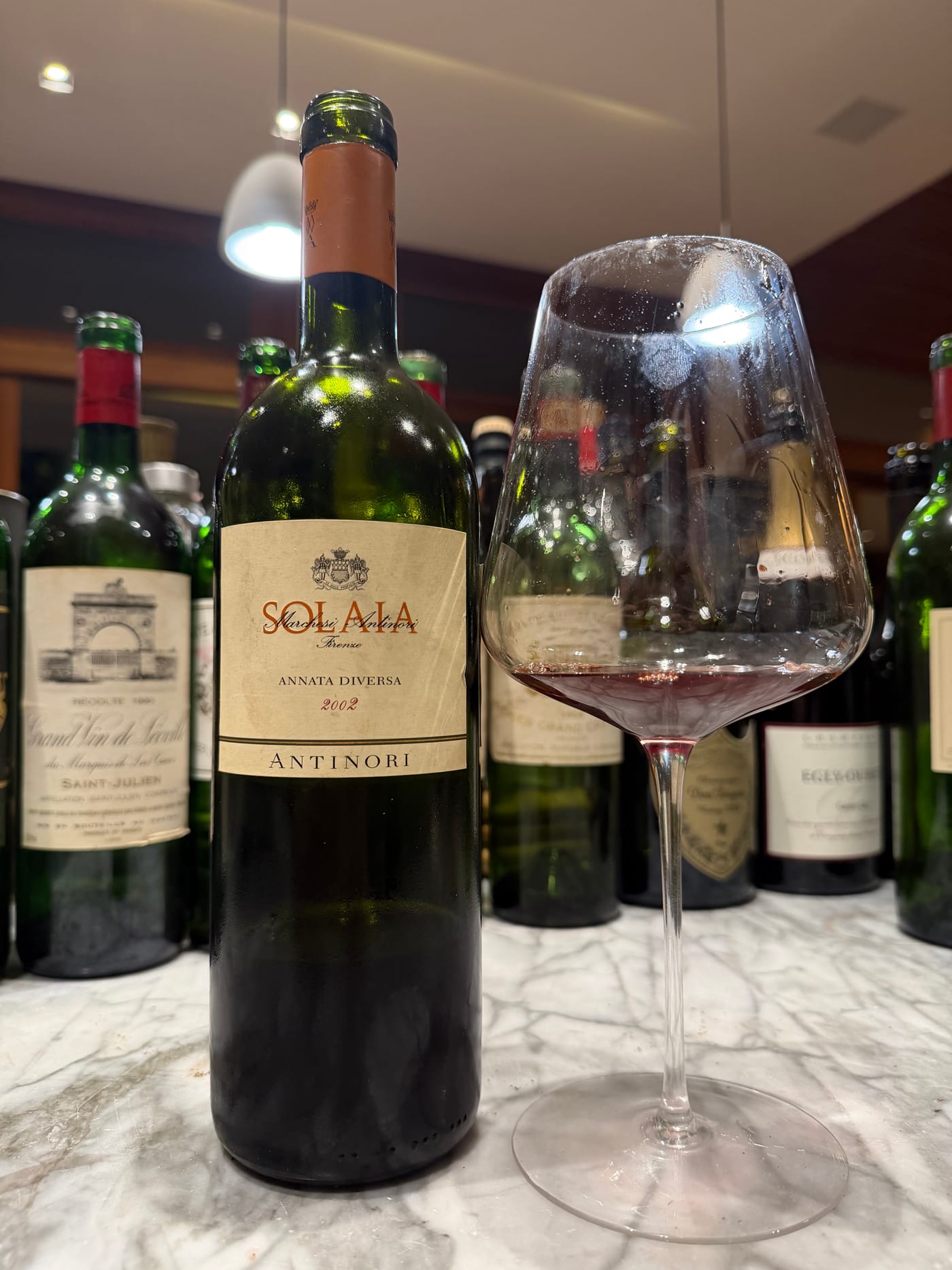
Solaia Annata Diversa 2002: A Different Vintage, a Singular Wine
Solaia 2002 is the only vintage to carry the words Annata Diversa, after a difficult Tuscan season removed Sangiovese from the blend. More than two decades later, the wine was alive, elegant and finely textured, with the composure of mature Bordeaux and an identity entirely its own.