Michelin Has Drawn a New Bordeaux Hierarchy. Why Is Latour Missing?
Michelin's first Bordeaux Grape Selection rearranges the order inherited from 1855. Château Latour's unexplained absence tests whether a modern classification can be both independent and transparent

The second MICHELIN Grape Selection rearranges the order inherited from 1855. Its boldest statement is also its least explained: Château Latour receives no Grape.
What happened
The MICHELIN Guide has released its first Grape Selection for Bordeaux, the second regional edition of a wine-rating system introduced in Burgundy in July. The corporate announcement counts 83 estates: nine awarded Three Grapes, 16 with Two, 37 with One and 21 included in the broader Selected category.
The nine top-rated estates are Château Léoville Las Cases, Château Lafite Rothschild, Château Montrose, Petrus, Château La Conseillante, Château Lafleur, Château Cheval Blanc, Château-Figeac and Château d'Yquem. The list immediately crosses hierarchies that Bordeaux has traditionally kept separate. It places Médoc classified growths beside unclassified Pomerol estates, Saint-Émilion properties and Sauternes under one producer-level distinction.
The result is not simply a guide to famous labels. It is an attempt to create a current order for Bordeaux, built around how estates farm, make wine, express identity and perform across vintages. That makes the ranking more ambitious than a collection of tasting scores. It also makes its omissions more consequential.
What the Grapes are supposed to measure
Michelin says its employed wine inspectors work collectively and apply five criteria: the quality of agronomy, technical mastery, identity, balance and consistency. The assessment is therefore presented as an evaluation of the producer as a whole, not of one bottle or one vintage.
Three Grapes are reserved for exceptional producers whose work can be approached with confidence regardless of the vintage. Two indicate outstanding quality and consistency within a region. One recognises producers of character and style, particularly in strong years. Selected is the entry category for estates Michelin considers dependable and worthy of continued review.
This language gives the vineyard unusual weight. Soil vitality, vine balance and care in the parcels sit beside vinification, oak, acidity, tannin and alcohol. Identity is explicitly part of the judgment. In principle, a famous château cannot rely only on reputation, and a less elevated historical rank does not prevent contemporary recognition.
Why this is not a new 1855 Classification
The comparison with 1855 is inevitable, but the two systems were built for different purposes. Napoleon III requested the 1855 Classification for the Paris Universal Exhibition. Bordeaux brokers organised estates largely through reputation and the market prices achieved by recent vintages. The result covered 60 red-wine properties in the Médoc, Château Haut-Brion in Graves, and 27 sweet-wine estates in Sauternes and Barsac.
Its commercial logic was direct and, by the standards of the period, legible. Price acted as a summary of established demand. Its weakness is permanence. The ranking became fixed even as ownership, vineyards, investment and wine quality changed. The only formal change in rank was the promotion of Château Mouton Rothschild from Second to First Growth in 1973.
Michelin starts from the opposite proposition. Its scope includes Pomerol and Saint-Émilion, regions outside the red-wine hierarchy of 1855. It uses contemporary viticulture and consistency as criteria, and says the selection will evolve each year. The 1855 Classification is a historical and commercial institution attached to specific estates. Michelin Grapes are a private editorial award. One does not legally replace the other.
The hierarchy Michelin has created
The value of the new system becomes visible where it refuses to reproduce the old order. Among the five red-wine First Growths now recognised by the 1855 hierarchy, only Lafite receives Three Grapes. Margaux, Mouton and Haut-Brion receive Two. Montrose and Léoville Las Cases, both Second Growths in 1855, sit in Michelin's highest group.
Pontet-Canet offers another clear example. A Fifth Growth in 1855, it receives Two Grapes, the same Michelin level as Margaux, Mouton and Haut-Brion. Pomerol, which had no place in the 1855 list, contributes Petrus, La Conseillante and Lafleur to the top tier. Château-Figeac, promoted to Premier Grand Cru Classé A in the revised Saint-Émilion classification of 2022, also receives Three.
These decisions are more than provocations. They reflect the difference between inherited status and current judgment. Michelin is saying that historical rank remains relevant, but it is not sufficient. Agronomy, stylistic identity and recent consistency can move a producer above an older legal hierarchy.
The Latour question
Château Latour is the conspicuous exception. It was one of the four original First Growths in 1855 and remains one of Pauillac's defining estates. Its historic Enclos occupies deep gravel close to the Gironde. The estate states that its entire vineyard has been farmed organically since August 2015, with biodynamic preparations used throughout the Enclos and on some outside parcels. In 2012, it also left the en primeur timetable, choosing to release wines later from its own cellars.
Those facts do not automatically entitle Latour to a Michelin distinction. A new guide has value only if it is willing to disagree with inherited prestige. If inspectors judged the estate and concluded that it did not meet the standard, exclusion would be evidence of independence, not an error.
The problem is that Michelin does not explain which of those possibilities applies. Its Bordeaux materials award Latour no Grape, yet do not say whether inspectors evaluated the estate, whether access or samples were unavailable, whether the château declined participation, or whether Michelin simply left it outside this first edition. Latour appears in the announcement only as a geographical reference for Léoville Las Cases and Pichon Baron.
That distinction matters. No award after a complete inspection is a judgment. No award because an estate was not inspected is an absence of evidence. Presenting both outcomes with the same silence asks readers to infer more than the guide has demonstrated.
What is confirmed
Michelin has established a four-level Bordeaux selection based on five published criteria and collective assessment by dedicated inspectors. The company says it intends to update and expand the selection annually. The top tier contains nine estates, and its ordering differs materially from the 1855 hierarchy.
Château Latour receives no Grape in the published 2026 Bordeaux awards. Lafite receives Three, while Margaux, Mouton and Haut-Brion receive Two. Montrose and Léoville Las Cases receive Three. Michelin has not presented individual scores or criterion-by-criterion reports for these decisions.
What remains unclear
Michelin has not disclosed the vintages tasted for each estate, the number of visits, the weight assigned to each criterion or the threshold separating one level from another. It has not explained whether all estates were assessed through the same combination of vineyard visit, cellar visit and multi-vintage tasting.
It has also not explained Latour's status. The public information does not allow readers to distinguish a negative assessment from non-participation, lack of access or an editorial decision to postpone coverage.
Even the launch totals require correction. Michelin's corporate release says 83 estates, including 37 with One Grape and 62 awarded at least one Grape. The Guide's English article currently says 84 estates, 38 with One Grape and 63 awarded. The remaining categories are identical. A system asking readers to trust a new hierarchy should publish one authoritative count.
TCJ View
The Michelin selection is useful precisely because it disturbs Bordeaux's inherited order. It recognises that a classification created from nineteenth-century prices cannot fully describe twenty-first-century vineyards. Montrose, Léoville Las Cases, Pontet-Canet, La Conseillante and Figeac show how farming, investment and stylistic evolution can alter the conversation without rewriting history.
Yet a moving classification creates a different obligation. If 1855 suffers from being fixed, Michelin risks suffering from being opaque. The five criteria sound more complete than price and reputation, but they become meaningful only when readers can see how they were applied.
Latour is therefore not a demand that Michelin restore the old hierarchy. It is a test of the new one. The guide does not owe every famous estate a distinction. It does owe readers the difference between an estate inspected and rejected, an estate not inspected, and an estate that chose not to participate.
The most interesting result would be that Michelin assessed Latour fully and still left it without a Grape. That would prove the guide is willing to challenge one of Bordeaux's strongest names. Until the method behind the omission is disclosed, however, the absence creates attention more effectively than understanding.
Sources
MICHELIN Group: Bordeaux Grape Selection announcement and official totals, September 8, 2026
MICHELIN Guide: Bordeaux Grape Selection feature and alternative totals, September 7, 2026
MICHELIN Group: Grape definitions, five criteria and inspector methodology
Bordeaux.com: history, scope and criteria of the 1855 Classification
Conseil des Vins du Médoc: the 1855 Classification and Mouton's 1973 promotion
Château Latour: First Growth history and withdrawal from en primeur
Château Latour: organic farming and biodynamic practices
WINE TASTING The Essential Guide
The Study Library · The Cellar Journal Wine tasting can look far more complicated than it really is. A professional puts their nose into a glass and starts talking about blackcurrants, violets, graphite, leather or wet stones, while someone listening may reasonably wonder whether all of those things are actually there,
ENGLISH WINE The Essential Guide
A complete introduction to English wine, connecting climate, geology, grapes, sparkling wine and modern history to explain how a marginal wine country became one of the world’s most dynamic cool-climate regions.
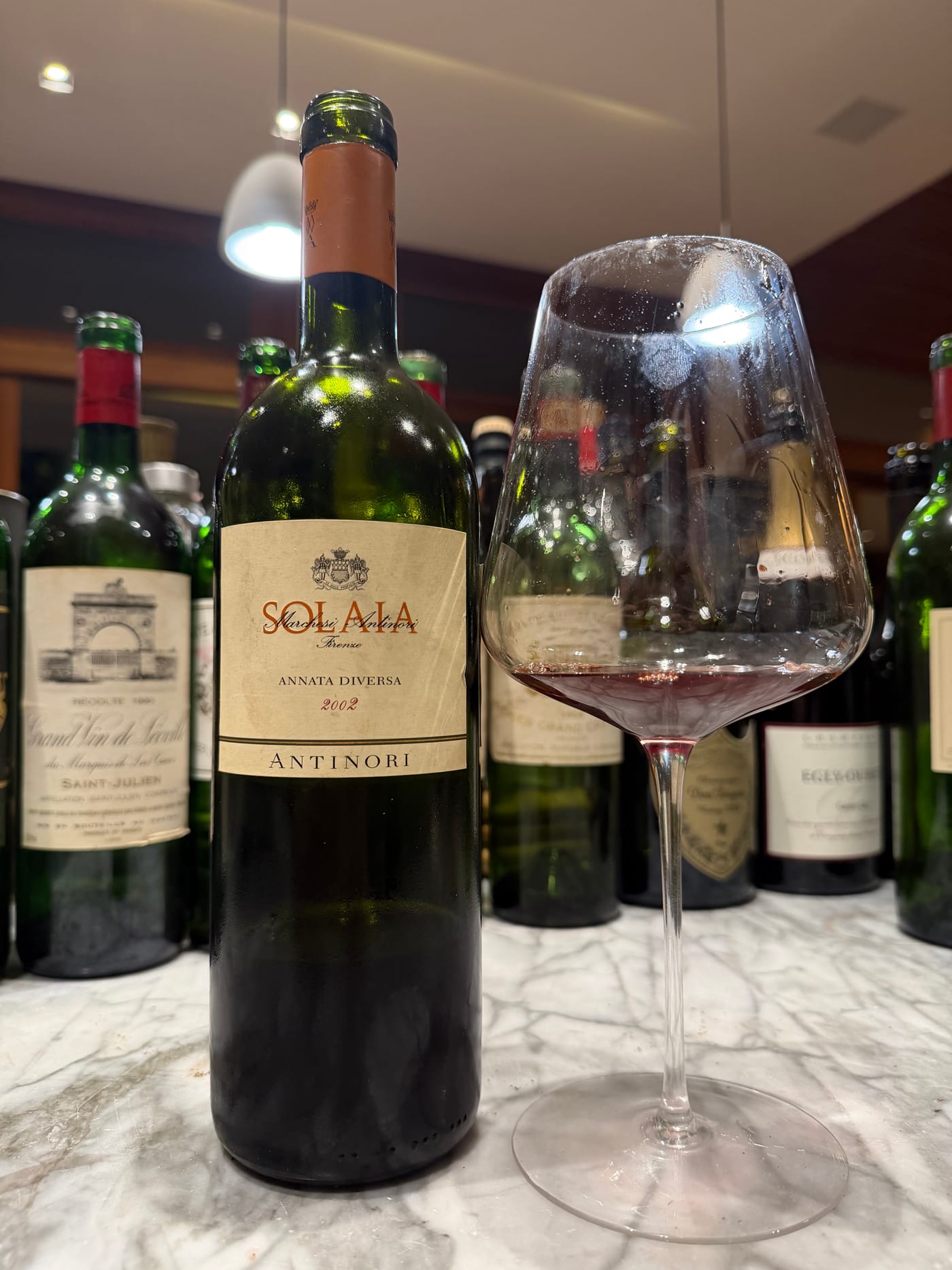
Solaia Annata Diversa 2002: A Different Vintage, a Singular Wine
Solaia 2002 is the only vintage to carry the words Annata Diversa, after a difficult Tuscan season removed Sangiovese from the blend. More than two decades later, the wine was alive, elegant and finely textured, with the composure of mature Bordeaux and an identity entirely its own.