In Chinon, Wine Is Becoming Part of the Literary Conversation
Chinon's seasonal Soif! meetings bring leading authors and local winegrowers into the same conversation. TCJ examines how a wine region builds cultural relevance beyond tourism.

A bookseller-led series brings leading French authors and local winegrowers together, showing how an appellation can build cultural relevance beyond tourism and sales.
What happened
Hélène Baudry, the bookseller behind Au Bonheur du Livre in Chinon, has become a central organiser of Soif!, a seasonal programme that places writers and winegrowers in the same public conversation. The meetings are organised by CePPages, an association created to explore the work behind books and wine rather than to use one as decoration for the other.
The format is compact. Two authors usually appear with a producer from the Chinon area, while established writers Muriel Barbery and Jean-Marie Laclavetine have moderated several editions. Events have been held at the Caves Painctes and the Maison des Vignerons et des Vigneronnes, placing literary discussion inside institutions already connected to the appellation.
This is not a single festival weekend assembled around celebrity names. Chinon's official association guide describes one Soif! meeting per season. The repetition matters because it turns an appealing idea into a small piece of local cultural infrastructure.
What is confirmed
CePPages' public programmes document a consistent sequence of writers and producers. A summer 2025 edition brought Abel Quentin and Jean Echenoz together with Jean-Martin Dutour of Baudry-Dutour. The following autumn paired Maylis de Kerangal and Nathalie Kuperman with Jérôme Billard of Domaine de la Noblaie.
The winter 2026 programme featured graphic novelist Étienne Davodeau, historian and writer Sylvain Venayre and winegrower Eric Ployet. In June, Akira Mizubayashi and Vincent Delecroix appeared with Sophie Clerc of Le Chai de Thélème. Other documented editions have included Daniel Pennac, Alexandre Postel and Chinon producer Béatriz Papamija.
The claim that these are among France's greatest authors remains an editorial judgement made by the source, not a measurable fact. What can be established is the calibre and continuity of the programme: Goncourt and major literary prize winners, widely published novelists, historians and graphic authors have participated alongside working winegrowers from the region.
Au Bonheur du Livre opened at its current address on Quai Jeanne d'Arc in late 2023 as an independent shop selling new and used books, with a tea-room component. The city profiled it in 2024, and public business records identify Hélène Baudry as its proprietor. CePPages' official listing names her as the association's president.
A regional language, not an invented pairing
Books and wine do not meet in Chinon by accident. The town belongs to the landscape of François Rabelais, whose work made appetite, language, knowledge and the social life of the table part of the same intellectual world. A separate annual festival, Les Nourritures Élémentaires, already brings writers, philosophers and historians to Chinon to examine that legacy.
That festival and Soif! are distinct initiatives and should not be conflated. Together, however, they show that the connection between literature and local agriculture is not an isolated marketing device. It has a historical reference, recurring organisers, physical venues and an audience that can encounter wine as part of a broader civic culture.
Touraine also provides a wider commercial precedent. Les Saisons, a wine shop and bookshop opened in Tours in 2020 by the Baudry-Dutour wine business, built a catalogue centred on wine and gastronomy. That project is separate from Baudry's shop and CePPages, but it confirms that books and wine have become a recognisable regional format rather than a one-off curiosity.
What remains unknown
No verified public figures establish attendance across the Soif! series, the size of its membership, its annual budget or the proportion of funding provided by ticket revenue, partners and public institutions. The available listings show prices ranging from free admission to EUR 12, but they do not provide a complete financial model.
There is also no evidence yet that the programme has increased book sales, winery visits, tourism nights or recognition of the Chinon appellation outside France. Those outcomes may not be its purpose, but without audience and impact data it would be premature to describe Soif! as a national cultural platform or an economic instrument for the region.
Its durability remains tied to a small independent shop, a volunteer association and the continuing ability to attract authors and producers. A seasonal rhythm is evidence of consistency, not proof of permanence.
TCJ View
Wine regions usually explain themselves through vineyards, cellars, restaurants and visitor routes. Chinon is testing another form of regional interpretation: the public conversation. Instead of asking literature to make wine appear more sophisticated, Soif! gives both forms of work a place at the table.
The importance lies less in the fame of any single guest than in the structure around them. An independent bookseller, local producers, recognised writers and appellation venues are collaborating repeatedly. That network allows wine to participate in the intellectual life of the town without requiring a museum, a luxury hospitality project or a large festival budget.
For TCJ, this is the more useful lesson. A region becomes culturally strong when wine is not only sold or explained, but used to connect agriculture with literature, history and the people who live there. Soif! is still small and its impact is not yet measurable. But it gives Chinon something many wealthier appellations do not possess: a recurring space where the meaning of the region can be discussed, rather than merely displayed.
Sources
La Nouvelle République: original profile of Hélène Baudry and the Chinon meetings between books and winehttps://www.lanouvellerepublique.fr/chinon/la-libraire-helene-baudry-fait-venir-les-plus-grands-auteurs-a-chinon-pour-des-rencontres-entre-livres-et-vins-1787586093
CePPages and HelloAsso: official association description and documented Soif! programmeshttps://www.helloasso.com/associations/ceppages
City of Chinon: official 2025 to 2026 association guide, CePPages officers and seasonal formathttps://www.ville-chinon.fr/fileadmin/contenu/documents/publications/guide_des_assos_2025-2026_pub_et_couv.web.pdf
City of Chinon: municipal profile of Au Bonheur du Livrehttps://www.ville-chinon.fr/fileadmin/contenu/documents/publications/chinonlemag_mars24v6bassedef.pdf
Chinon winegrowers' association: Rabelais, Les Nourritures Élémentaires and the town's cultural contexthttps://www.chinon.com/experimentez-chinon/
Livres Hebdo: the wider bookshop and wine-shop model in Tourainehttps://www.livreshebdo.fr/article/le-livre-et-le-vin-se-marient-bien-en-touraine
WINE TASTING The Essential Guide
The Study Library · The Cellar Journal Wine tasting can look far more complicated than it really is. A professional puts their nose into a glass and starts talking about blackcurrants, violets, graphite, leather or wet stones, while someone listening may reasonably wonder whether all of those things are actually there,
ENGLISH WINE The Essential Guide
A complete introduction to English wine, connecting climate, geology, grapes, sparkling wine and modern history to explain how a marginal wine country became one of the world’s most dynamic cool-climate regions.
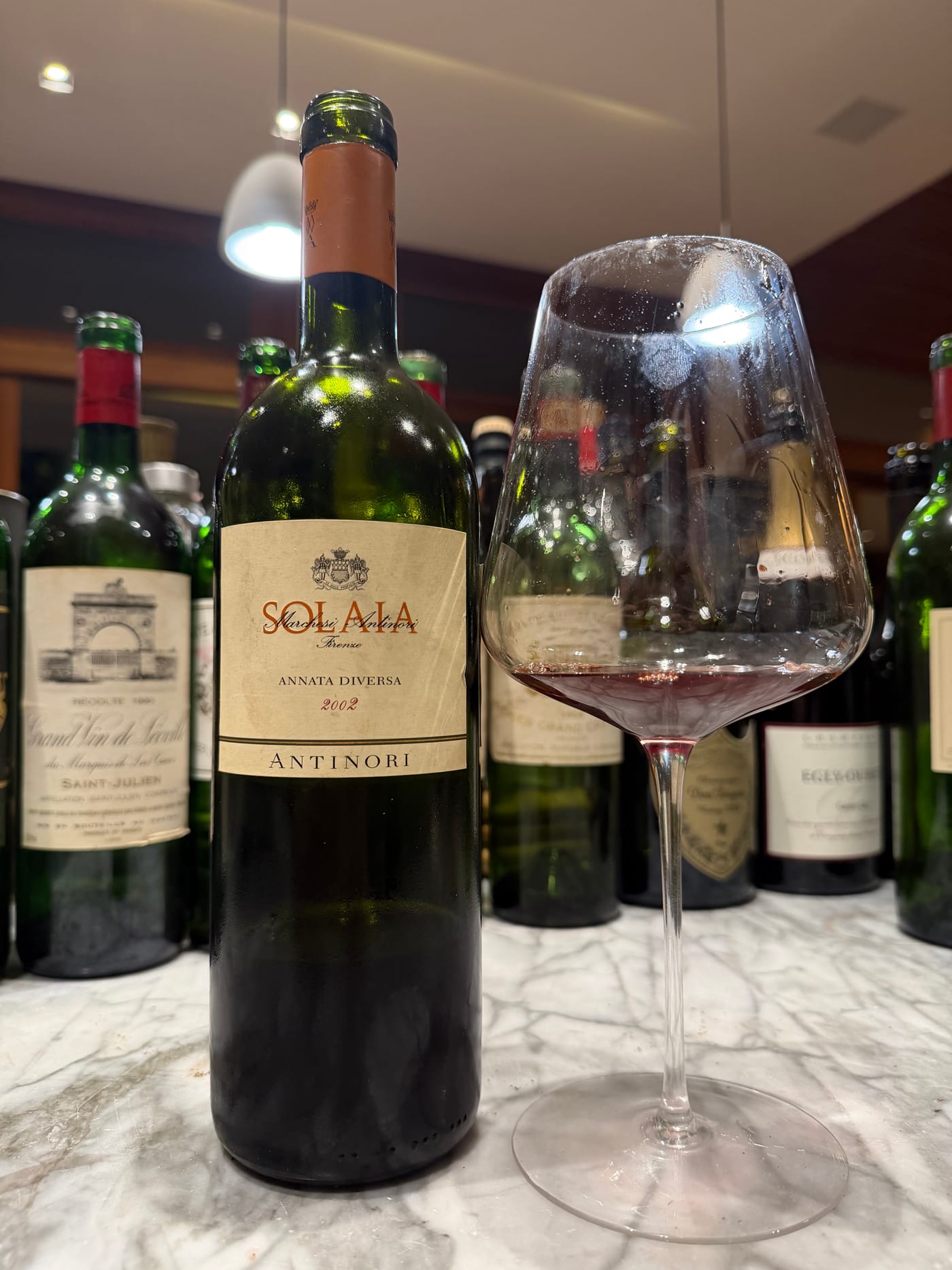
Solaia Annata Diversa 2002: A Different Vintage, a Singular Wine
Solaia 2002 is the only vintage to carry the words Annata Diversa, after a difficult Tuscan season removed Sangiovese from the blend. More than two decades later, the wine was alive, elegant and finely textured, with the composure of mature Bordeaux and an identity entirely its own.