Georg Stiegelmar, a Builder of Modern Burgenland, Dies at 86
Georg Stiegelmar, the JURIS patriarch who helped establish the quality ambitions of Gols and Neusiedlersee red wine, has died aged 86. TCJ examines the work behind his regional legacy.

The JURIS patriarch helped establish a quality language for Gols and Neusiedlersee red wine before the region possessed the formal origin framework it has today.
What happened
Georg Stiegelmar, the long-serving patriarch of the JURIS estate in Gols and one of the figures associated with the rise of quality red wine in Burgenland, died on August 17, 2026. JURIS gives his dates as April 21, 1940 to August 17, 2026, which means he was 86. His family announced the death but did not publish a cause.
That age matters because several reports rendered a German expression meaning that he was in his 87th year of life as though he had died aged 87. The exact dates supplied by the family resolve the discrepancy. It is a small correction, but one that belongs in a factual account of a career built over nearly six decades.
A career before the modern Austrian reset
Stiegelmar trained in viticulture and cellar management during the 1960s and took over his parents' business in 1967. He therefore began shaping JURIS well before the legal and commercial rebuilding that transformed Austrian wine after 1985. His importance is not that he arrived after the reset. It is that his work already belonged to the quality movement that would make the reset credible.
Gols sits east of Lake Neusiedl, within a warm Pannonian landscape historically capable of producing both sweet wines and ripe reds. Today Neusiedlersee has a formal DAC identity, introduced with the 2012 vintage and centred on regional Zweigelt. Stiegelmar's formative decades came before that system. Regional identity then depended less on an official designation than on growers proving what the area could consistently produce.
Building a red-wine vocabulary in Gols
Official and regional accounts place Stiegelmar among the people who drove the development of Austrian red wine in the 1980s. At JURIS, Pinot Noir and St Laurent became particular reference points. These varieties did more than expand a range. They helped move the conversation around Gols from volume and category toward site, variety, cellar precision and the capacity of Burgenland reds to stand in an international context.
It would be inaccurate to attribute the transformation of an entire region to one estate or one person. Burgenland's modern reputation was collective, built by growers, researchers, merchants and later by origin rules. Stiegelmar's role was more specific and more durable: he helped establish the expectation that a producer from Gols could work at a level measured beyond the local market.
Innovation, with attribution
JURIS credits Stiegelmar's advocacy with helping secure recognition in Austrian wine law for Strohwein, or straw wine, as well as provisions concerning egg-white fining and white wine made from dark-skinned grapes. Those claims appear in the estate's own account and should be understood as the family's record of his influence, rather than as independently documented legislative authorship by one individual.
The distinction does not reduce the substance of the legacy. Strohwein requires grapes to be dried before fermentation, concentrating their sugars and flavours. Protecting the category in law helped preserve a traditional production method inside Austria's modern quality system. The larger pattern is clear: Stiegelmar worked not only on what JURIS could make, but also on the rules through which such wines could be recognised.
Recognition and succession
Recognition followed across several decades. Falstaff named him Winemaker of the Year in 1988. In 1995, he received the International Wine and Spirit Competition's Winemaker of the Year title in London. In 2023, Burgenland awarded him its Great Golden Decoration of Honour, an official acknowledgement of his contribution to the state.
The estate also records the central role of his wife, Theresia, in the work they developed together. Succession was not left to the final stage of his life. Georg transferred management to his son Axel in 2000, allowing the next generation to lead while the elder Stiegelmar remained part of the estate's continuity. That transition matters in a family business whose winegrowing history is traced to 1571.
What remains uncertain
No public source reviewed by TCJ states the cause of death. Nor is there a single independent archive that quantifies how much of each legal change resulted from Stiegelmar's intervention. The strongest account is therefore one that separates confirmed dates, awards and positions from the estate's own description of his legislative influence.
There is also a risk in obituary language. Terms such as pioneer and quality engine can become substitutes for evidence. In Stiegelmar's case, the evidence lies in the sequence: taking responsibility in 1967, participating in the 1980s red-wine advance, receiving international recognition in 1995, transferring management in 2000 and remaining connected to a regional identity that was later formalised through DAC.
TCJ View
Wine regions are not built only when authorities approve a designation. They are built earlier, when a small group of producers changes what neighbours, merchants and international buyers believe a place can be. Georg Stiegelmar's most important work belongs to that earlier stage of Burgenland's development.
He helped give Gols and Neusiedlersee a quality vocabulary before the region possessed today's institutional language. Pinot Noir and St Laurent, technical experimentation and engagement with wine law were different parts of the same project: making origin credible through practice. Awards confirmed that work, but they did not create it.
The measure of the legacy is therefore not whether every innovation can be assigned to one person. It is whether the regional ambition survives him. JURIS has already passed through an organised succession, and Neusiedlersee now has the formal framework that Stiegelmar's generation did not. His death closes one career, but the standards that career helped normalise have become part of the region's permanent expectations.
Sources
JURIS: official family notice, exact birth and death dates, career milestones and the estate's account of his legal advocacyhttps://www.juris.at/
JURIS: Georg and Theresia Stiegelmar, succession and 1995 international recognitionhttps://www.juris.at/en/weingut/unserteam/georg-theresia/
ORF Burgenland: independent obituary and career chronologyhttps://burgenland.orf.at/stories/3367855/
Burgenland government: official record of the 2023 Great Golden Decoration of Honourhttps://www.burgenland.at/news-detail/landesauszeichnungen-vergeben-lh-doskozil-koennen-stolz-auf-die-entwicklung-unseres-heimatlandes-sein/
Renommierte Weingüter Burgenland: JURIS profile, regional role and 2000 transfer of managementhttps://www.rwb.at/weingut-juris/?lang=en
Austrian Wine: official Neusiedlersee profile and DAC chronologyhttps://www.austrianwine.com/our-wine/winegrowing-regions/burgenland/neusiedlersee
Wein.plus: original news leadhttps://magazine.wein.plus/news/austrian-wine-pioneer-georg-stiegelmar-has-died-quality-engine-of-the-neusiedlersee-region-turned-87-years-old

WINE TASTING The Essential Guide
The Study Library · The Cellar Journal Wine tasting can look far more complicated than it really is. A professional puts their nose into a glass and starts talking about blackcurrants, violets, graphite, leather or wet stones, while someone listening may reasonably wonder whether all of those things are actually there,
ENGLISH WINE The Essential Guide
A complete introduction to English wine, connecting climate, geology, grapes, sparkling wine and modern history to explain how a marginal wine country became one of the world’s most dynamic cool-climate regions.
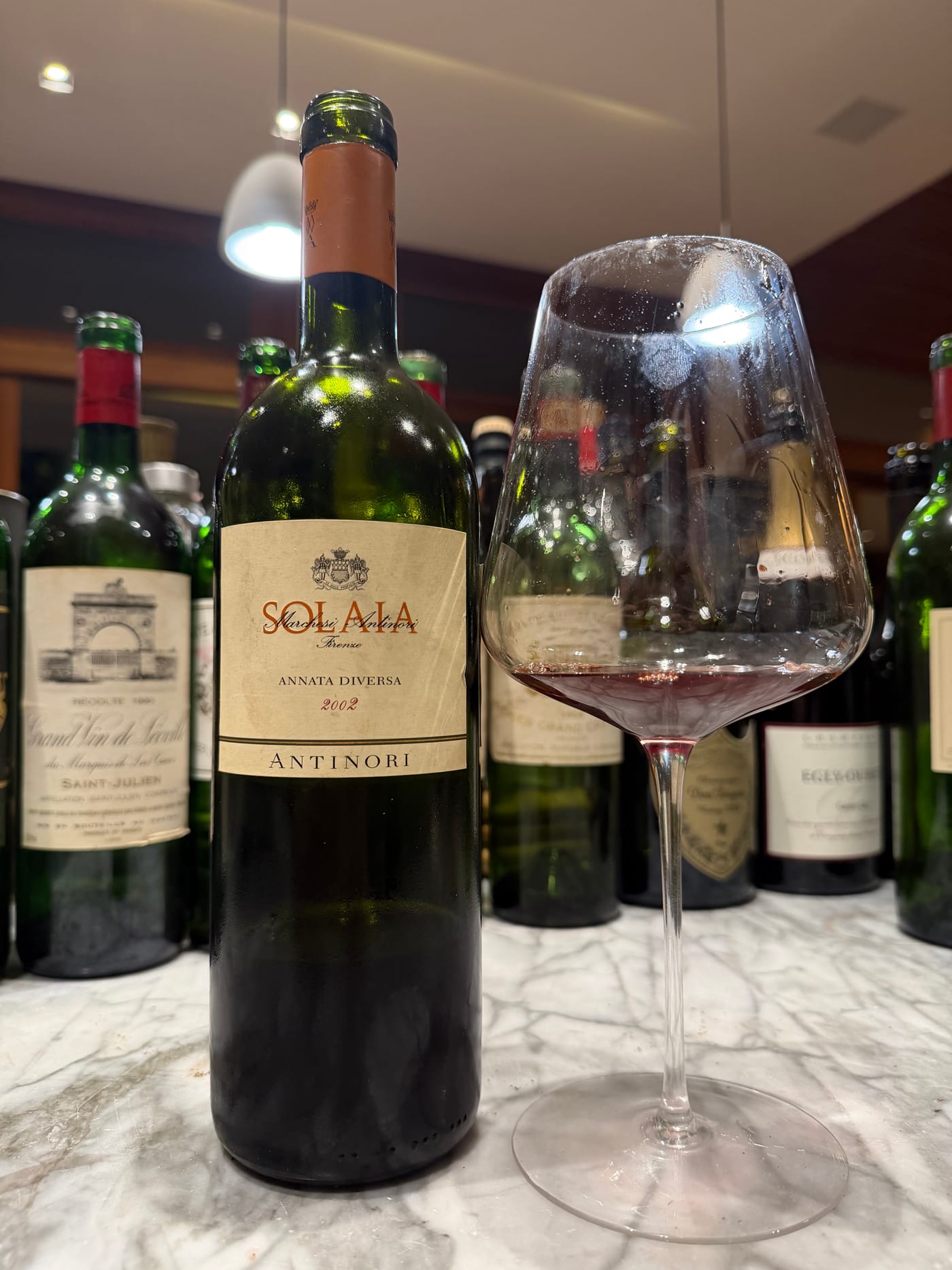
Solaia Annata Diversa 2002: A Different Vintage, a Singular Wine
Solaia 2002 is the only vintage to carry the words Annata Diversa, after a difficult Tuscan season removed Sangiovese from the blend. More than two decades later, the wine was alive, elegant and finely textured, with the composure of mature Bordeaux and an identity entirely its own.