Abruzzo · Legacy
The Patience
of Emidio Pepe
In Abruzzo, Emidio Pepe built a 350,000-bottle archive as an argument for waiting.
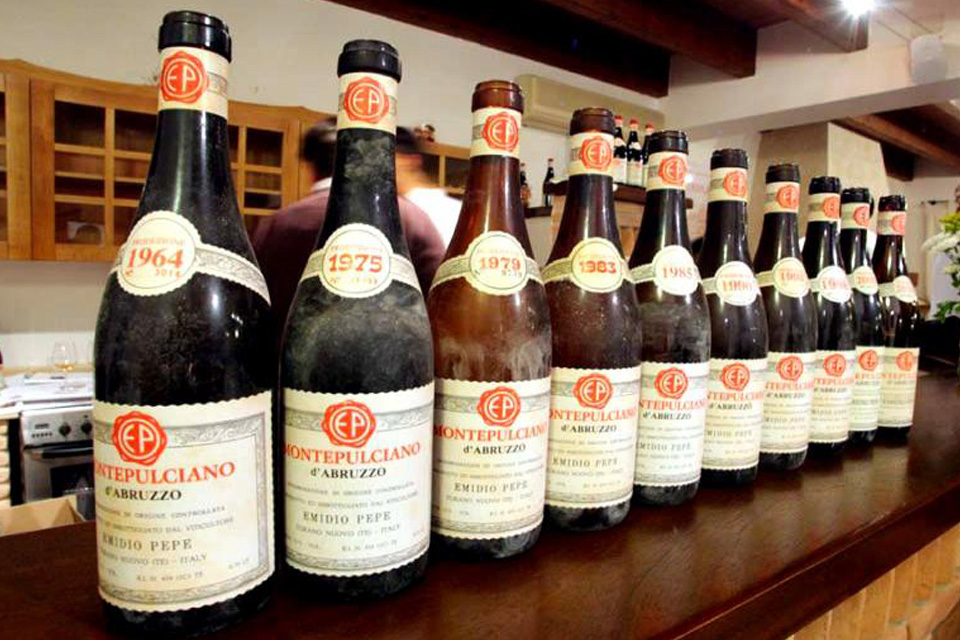
During a visit to the estate in Torano Nuovo in 2019, the first impression was not of a vineyard but of an archive. Rows of bottles, some labeled by hand, ran back through vintages that predated the visitors by decades. Nothing about the room asked to be admired. It simply sat there, patiently, doing what it had been built to do: demonstrate that a wine could wait.
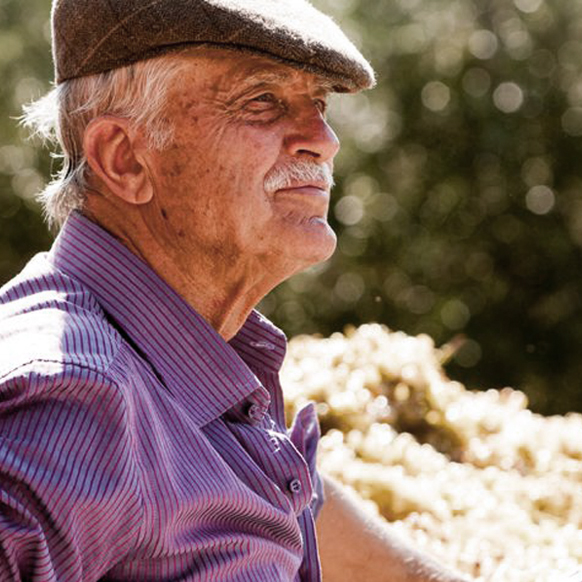
Emidio Pepe died on July 28, 2026, in that same town, at the age of 94. The tributes that followed, from Italy’s agriculture ministry to wineries across Abruzzo, called him a visionary and, more specifically, “Mister Montepulciano”, a nod to his decades-long campaign to have the region’s signature red taken seriously outside Italy. Both are accurate. Neither fully explains what made him unusual.
Pepe’s real innovation was not a technique. It was a position on time.
In 1964, when he began bottling the wine his family had farmed since the late nineteenth century, almost nothing about his approach was fashionable, least of all in Abruzzo, a region better known then for volume than ambition. He crushed white grapes by foot and destemmed reds by hand. He fermented spontaneously, in glass-lined concrete rather than steel or oak, and refused filtration. The methods were not designed to imitate modern natural-wine language. They came from a belief that intervention should never obscure the character of the vineyard.
But the decision that mattered most was simpler and harder to imitate: he kept back at least half of what he made, aging it in the family cellar for years, sometimes decades, before release. The cellar now holds more than 350,000 bottles spanning over thirty vintages, a private ledger of one family’s patience.
That patience was also a wager. It assumed the wine was worth the wait, that critics and collectors would eventually agree, and that the family could afford to sell nothing for years while a vintage matured in the dark. It is easy, in hindsight, to call this vision. In 1964, it was closer to stubbornness.
What we tasted that day reflected that stubbornness directly. Pecorino, Trebbiano and Montepulciano were poured without ceremony, in a setting that felt deliberately simple. The focus stayed on the vineyard and on styles that spoke plainly for themselves, without winemaking dressed up to disguise anything. Yet the precision was visible in the details, including Zalto stemware selected with the same deliberateness as everything else on the property. Rustic and precise were not in tension here. They were the same idea, applied to different parts of the operation.
A discipline passed forward
That combination did not happen on its own. For the past two decades, Pepe’s daughters, Sofia and Daniela, have helped direct the family business. His granddaughters now hold operational roles of their own. Chiara De Iulis Pepe, who studied viticulture and oenology in Burgundy, has overseen vineyard management and winemaking at the estate since the 2020 vintage. In 2026 she also became head of viticulture and winemaking at Domaine de la Chapelle, part of Paul Jaboulet Aîné, in the Rhône. Elisa De Iulis Pepe runs hospitality, including the agriturismo.
None of that fluency was optional. A wine that will not speak for a decade cannot be sold with urgency. It has to be explained, contextualized and defended to a market trained to prefer the newest release over the most resolved one. Growing up inside that constraint appears to have pushed the family outward rather than inward, toward Burgundy, international markets and a working knowledge of how wine is discussed well beyond Abruzzo. Their grandfather’s insistence on time produced, as a byproduct, a family fluent in distance.
An unresolved legacy
It would be a mistake to read all of this as a settled triumph. Pepe’s wines have long divided opinion. For some critics and drinkers, their oxidative edges and rustic textures represent honesty. For others, they are flaws that more controlled winemaking might have avoided. That disagreement is not new, and his death does not resolve it.
What Emidio Pepe leaves behind, then, is not simply a vineyard or a brand. It is a stance: that the most valuable thing a winemaker can do is refuse to rush, and that a family’s clearest inheritance can be a discipline rather than an asset. Whether that discipline can survive another generation, in a market increasingly organized around immediacy, remains unanswered. It is, fittingly, a question that will take years to resolve.
Reporting notes
Estate history, family roles, cellar holdings and production methods were checked against the producer’s published records. The date of death was corroborated by contemporary reporting.